Which Language Should You Translate Your Book Into?
Compare German, Spanish, French, Italian and Portuguese book markets to choose the best language and audience for your next translation.

Written by Teddy Smith
BookLingua founder, author and host of The Publishing Performance Show
Table of Contents
- The short answer
- Choose a market, not just a language
- Readers are already buying translated English books
- Should you translate your book into German?
- Should you translate your book into Spanish?
- Should you translate your book into French?
- Should you translate your book into Italian?
- Should you translate your book into Portuguese?
- Look at your existing readers first
- Find authors whose books resemble yours
- Check the local bestseller charts
- Don’t forget the rest of the series
- Think about marketing before you translate
- A simple way to compare your options
- So, which language should you choose?
- What happens next?
- Frequently asked questions
- What is the best language to translate a book into?
- Should I translate my book into Spanish or German?
- Can I use one Spanish translation in several countries?
- Should I use Brazilian or European Portuguese?
- Should I translate one book or the whole series?
- Do I need new keywords for the translated edition?
- Will I need to change the cover?
Translating your book can give it a second life. You’ve already done the hard work of writing it. A translation allows you to take that same book to a completely new group of readers.
And those readers are already buying stories translated from English.
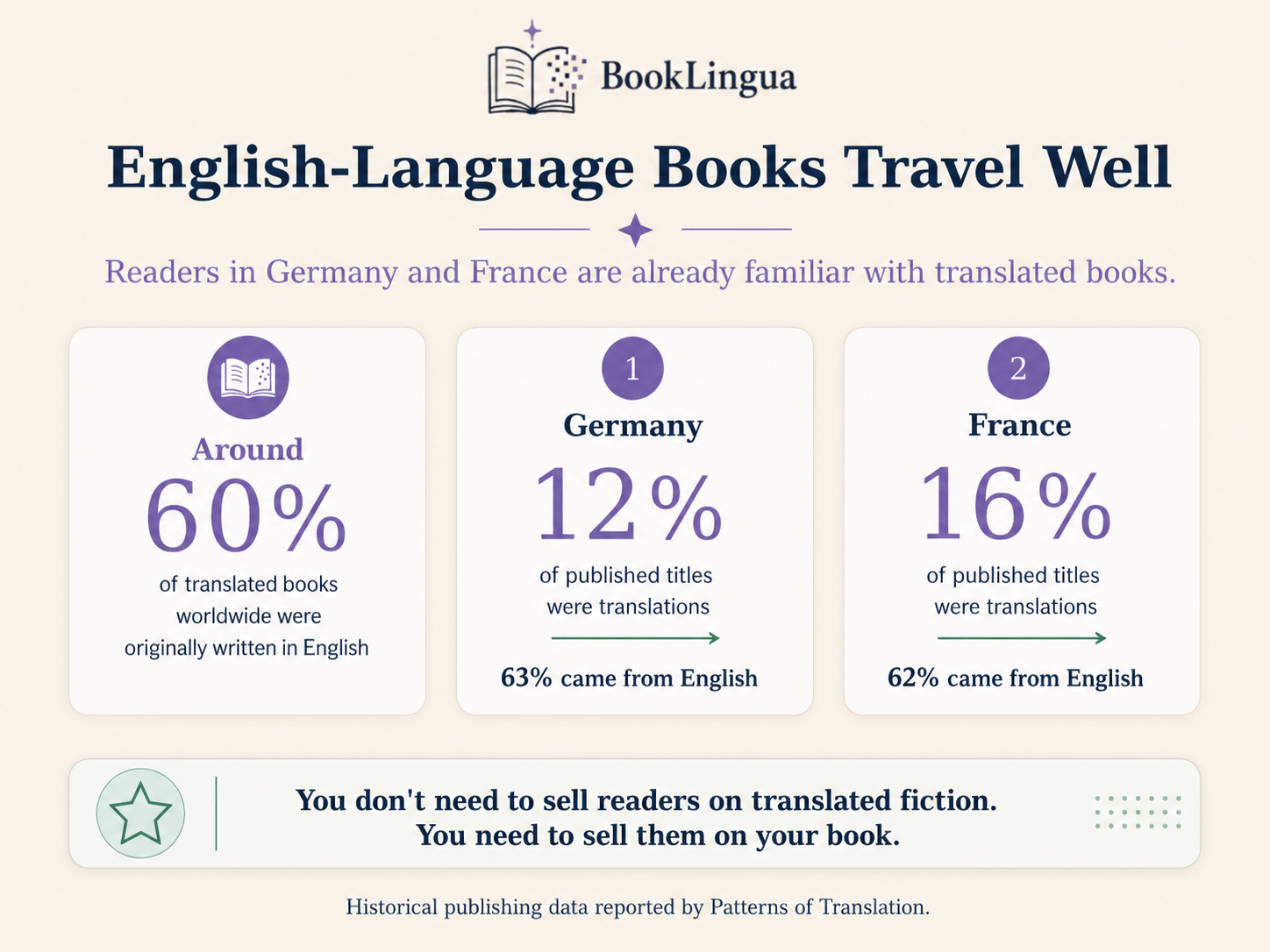
The Index Translationum reports that around 60% of translated books worldwide are originally written in English, so a large number of readers are clearly more than happy to read translations. The trickier part is working out the language and markets where your particular book has the best chance.
German is often recommended because Germany has one of Europe’s largest book markets, but Spanish is spoken by hundreds of millions of people so that market can’t be ignored either. French, Italian and Portuguese all offer opportunities too for authors.
But it’s not always about targeting the biggest language or largest possible population. It’s more important to identify the market where people buy books like yours, and where you have a realistic way of reaching them.
In this guide, we’ll look at five of the main options for independent authors: German, Spanish, French, Italian and Portuguese.
If you want to understand what happens after you’ve chosen a language, read our step-by-step guide to translating a book with AI.
The short answer
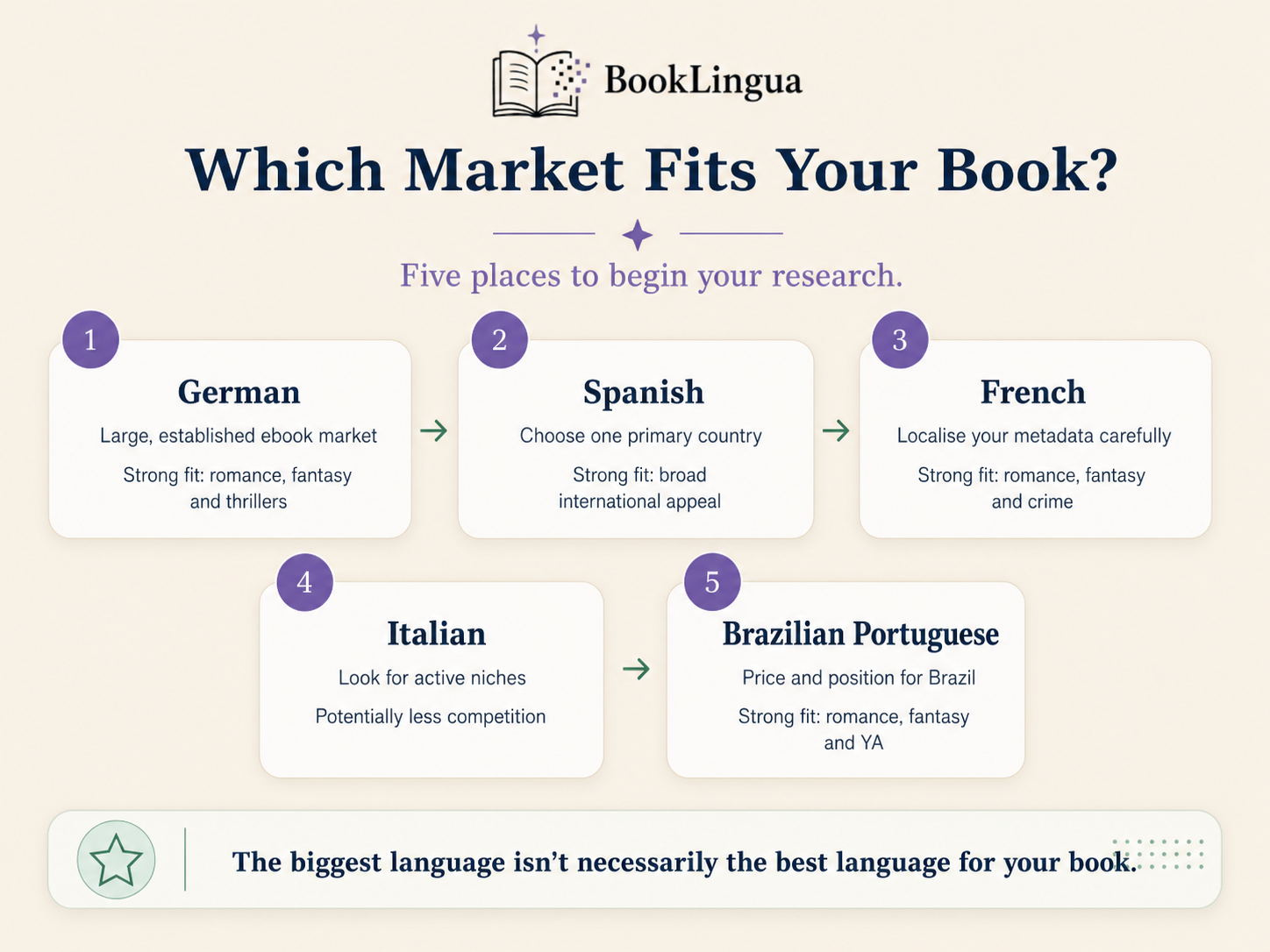
For many independent authors, German is the best place to start researching.
That’s because Germany has a large book market, an established ebook audience and plenty of readers of commercial fiction. Romance, fantasy, thrillers, science fiction and young adult books can all do well there.
But you still need to do your research, because your genre, existing readership and ability to market the translation matter more than the total size of the market.
If for example you’re a romance author who already has Brazilian readers you may be better off translating into Brazilian Portuguese. Similarly if your Amazon dashboard shows a surprising number of book sales in France, then French deserves a closer look.
Start with the evidence around your own book.
Choose a market, not just a language
A language and a market aren’t the same thing.
Spanish is spoken in Spain, Mexico, Argentina, Colombia and many other countries. Those readers don’t necessarily use the same vocabulary, pay the same prices or buy their books from the same places.
Portuguese is another obvious example. If you’re targeting Brazil, you need Brazilian Portuguese. A translation written for readers in Portugal can sound stiff or unfamiliar to a Brazilian reader.
Before you translate anything, think about:
- Which country is your main target?
- Who is the book for?
- Where do those readers buy books?
- What language conventions do they expect?
- How are you going to reach them?
Don’t worry, you can still translate your book more widely, but choosing one primary market makes decisions about the translation, cover, description, keywords and pricing much easier.
Readers are already buying translated English books
If you’re an English-language author, you have one big advantage: English is the dominant source language for translated books.
A recent report found that translations represent around 12% of the books published in Germany and almost 16% in France. Approximately 63% of those German translations and 62% of the French translations had originally been written in English.
French and German readers are already very comfortable buying books that began life in English. You don’t need to persuade them that translated fiction is worth reading, you just need to persuade them that your book is for them!
A large translation market doesn’t guarantee sales, but it certainly makes it easier.
Should you translate your book into German?
I regularly recommend German for independent authors. Germany has one of Europe’s largest book markets, a well-established ebook audience and a strong appetite for translated books.
German readers buy through Amazon as well as the Tolino network used by several major booksellers.
It’s a particularly good market for:
- Romance and romantasy
- Fantasy and science fiction
- Crime and thrillers
- Young adult and new adult fiction
- Some practical and specialist nonfiction
But the downside is competition. A large market attracts other authors, including plenty of established English-language authors with German editions. Simply publishing a translated book isn’t enough.
You need to make sure your book can compete and that means a natural translation, a suitable cover, properly researched keywords and a book description written to sell the story to German readers.
Search Amazon.de and the Tolino shops for books that genuinely resemble yours. Don’t just search for “romance” or “fantasy”. Look at your particular subgenre, tropes, tone and readership.
If comparable authors have translated several books into German, that’s a good sign. They probably wouldn’t keep doing it if nobody were buying them.
Should you translate your book into Spanish?
Spanish gives you access to an enormous potential audience, but there isn’t one single Spanish book market.
You could be targeting Spain, Mexico, the United States or readers across Latin America. A broadly accessible Spanish translation can be sold in all these places, but your pricing and marketing may still need to change between countries.
Spanish could be a good choice if:
- You already have readers in a Spanish-speaking country
- Your genre is visible in the Spanish-language bestseller charts
- Your book has broad international appeal
- You can connect with Spanish-speaking reviewers or creators
- You’re prepared to focus your marketing on a particular country
But don’t translate into Spanish just because it has more speakers than German.
A huge potential audience doesn’t help if ebook sales in your genre are limited, your price is wrong for the market or you have no practical way to reach readers.
Choose one country as your initial focus. You can then sell the same translation elsewhere while adapting the metadata, price and promotion.
Should you translate your book into French?
France has a large publishing market, a strong reading culture and a long history of publishing books translated from English.
Amazon is important, but French readers also buy books through retailers such as Fnac, Cultura and Kobo. According to a recent report in The Guardian, printed books are still selling well in France, so it may make sense to release both ebook and paperback editions.
French is worth investigating for genres including:
- Romance
- Fantasy
- Crime and thrillers
- Children’s books
- Commercial and literary fiction
- Lifestyle and practical nonfiction
One thing to be careful of is French metadata. When working on a romance title, for example, we found that the most obvious translation of “enemies to lovers” wasn’t necessarily the phrase French readers were using to find those books.
We discovered that de la haine à l’amour (“from hate to love”) was actually a more accurate phrase. A good reminder that you need to translate the reader’s search, not just the English keyword.
The same applies to your title, subtitle, description and advertising.
Should you translate your book into Italian?
Italy is sometimes overlooked in favour of Germany, France and Spain.
But that could actually work in your favour. In some genres, you may find fewer translated independent books competing for readers’ attention.
On the other hand, lower competition doesn’t always mean a hidden goldmine so you’ve got to do your research. Sometimes there are fewer books because there are fewer buyers.
Italian could be worth exploring if:
- Books like yours are selling on Amazon.it
- Comparable authors have successful Italian editions
- Your subject or setting appeals particularly to Italian readers
- You can reach Italian reviewers or book communities
- Your niche looks active but isn’t overcrowded
Make sure to research your precise subgenre. A market can be weak overall while a particular category performs well. Equally, a thriving publishing industry doesn’t guarantee demand for your specific type of book.
Should you translate your book into Portuguese?
For most independent authors, translating into Portuguese really means targeting Brazil.
Brazil has a huge population and an active community of younger, digitally engaged readers. Romance, fantasy and young adult books can be really popular.
There are challenges, though. Local ebook prices and purchasing power can be very different from the US, UK or Western Europe.
Brazilian Portuguese may suit your book if:
- You already hear from Brazilian readers
- Your genre has an active Brazilian online community
- You can work with local reviewers or creators
- Your book suits subscription reading or promotional pricing
- You’re prepared to set a price appropriate for Brazil
If Brazil is the market, make sure you use Brazilian Portuguese as European and Brazilian Portuguese aren’t interchangeable.
The wrong version won’t necessarily make the book impossible to understand, but it can make the dialogue and narration feel unnatural.
Look at your existing readers first
You can tap into some invaluable data just by reviewing your existing customers and sales. Look at your:
- Amazon sales by marketplace
- Kindle Unlimited reads by country, where available
- Website traffic
- Newsletter subscribers
- Social media followers
- Reader messages
- International reviews
- Advertising results
You may already have the beginning of an audience somewhere, and if so then that could be a great place to start.
A handful of English-language sales in Germany doesn’t prove that you should commission a German translation. But regular sales, website visits and reader messages from the same country are worth investigating.
Your own readers are usually a better clue than the total number of people who speak a language.
Find authors whose books resemble yours
Next, look at comparable authors in your niche. Look for books with a similar:
- Genre and subgenre
- Tone
- Readership
- Heat or violence level
- Price
- Series length
- Publishing model
Then see which languages those authors have translated into. Look at publication dates, rankings, reviews, covers and prices.
Review numbers won’t tell you exactly how many copies a book has sold, but they can show whether the edition has found an audience.
Pay particular attention to authors who have released several books in the same language. Translating one book might have been an experiment but translating six books suggests that they’re tapping into a lot of readers.
Check the local bestseller charts
Visit the marketplace where you would actually sell the book, for example:
- Amazon.de for Germany
- Amazon.es for Spain
- Amazon.fr for France
- Amazon.it for Italy
- Amazon.com.br for Brazil
Search using local-language terms and open the categories closest to your book. For example if you’re a romance author, you could search Liebesroman (romance novel) on Amazon.de.
Look at the covers, prices, titles, descriptions, reviews and rankings. Ask yourself:
- Are books like mine selling?
- Can I see independent authors?
- Are translated books common?
- What do successful covers look like?
- Which tropes or benefits are mentioned?
- Are readers buying standalones or series?
- What price feels normal?
Just a couple of focused hours should tell you whether a market deserves further attention.
Don’t forget the rest of the series
If your book is part of a series, it’s worth calculating the cost of translating the later books before you begin.
You can translate Book One first to test demand. You don’t need to pay for the entire series immediately, but if Book One succeeds, readers will want the next book. A three-year wait isn’t ideal, particularly if the first one ends with your heroine discovering that her fiancé is secretly an immortal dragon!
Before starting, make sure you know what your future costs will be. You should also create a glossary and style guide that can be reused across the series. Character names, magical objects, invented places and recurring phrases need to remain consistent from one book to the next.
Before uploading the manuscript, read our guide to preparing your book for translation. A clean manuscript and a clear translation brief prevent a lot of unnecessary corrections later.
Think about marketing before you translate
Translation makes your book available, but it doesn’t make it visible.
Before choosing a language, you need to identify at least two or three ways you could reach readers in that market. That could be:
- Amazon advertising
- Local book promotion services
- Book bloggers and review teams
- BookTok or Instagram creators
- Newsletter swaps
- Free or discounted promotions
- Kobo or Tolino promotions
- Your existing mailing list
You don’t necessarily need to have a huge launch campaign worked out in advance, but just uploading it to Amazon without any other marketing could leave you missing out on sales.
A smaller market where you have useful contacts may be a better choice than a larger one where you’re starting completely from scratch.
A simple way to compare your options
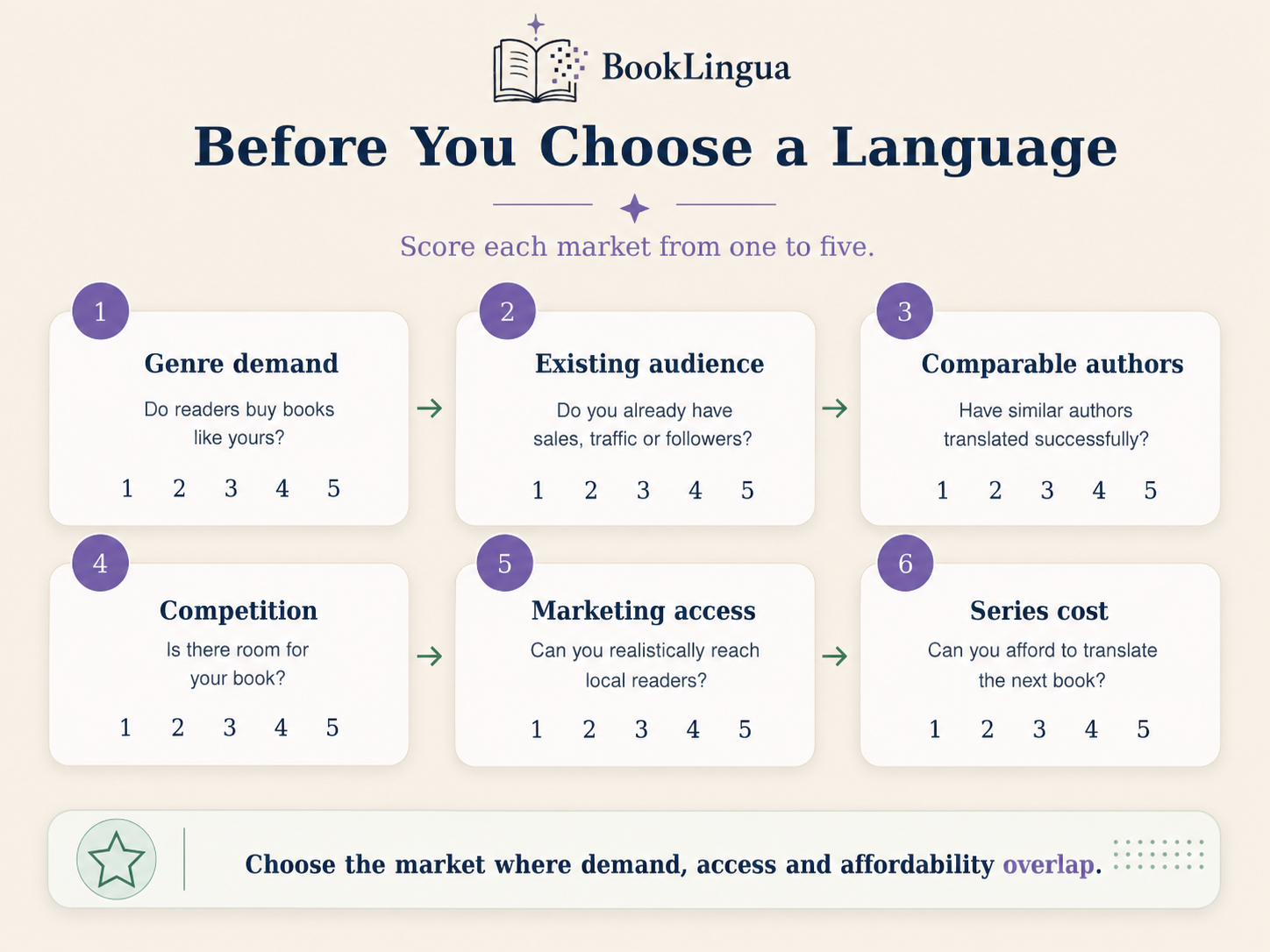
If you’re deciding between two or three languages, use the handy score card below and give each factor a ranking between 1 and 5 (1 being low and 5 being high) to help you decide which language to choose:
Remember 10 million relevant readers are more useful than 300 million people who have no interest in your book.
So, which language should you choose?
For most independent fiction authors, I would research German first.
It combines a large book market, an established ebook audience, a strong appetite for translated English-language books and visible demand for several popular indie genres.
I would consider Spanish if you already have interest from a particular Spanish-speaking country or want to develop a wider international audience.
French is a strong option if your genre is performing well and you’re prepared to localise the positioning carefully.
Italian may suit authors who uncover an active niche with less competition.
Brazilian Portuguese could be a very good fit for books aimed at younger, highly engaged online readers, particularly if you already have signs of interest from Brazil.
Ultimately though you need to choose the market where there’s demand for your kind of book, where the competition looks manageable and where you can see a way to market your book to readers.
What happens next?
Once you’ve chosen a language, you’ll need to prepare the manuscript, create a translation brief, translate and validate the book, arrange human review, format the files and localise the sales material.
Our guide to translating a book with AI takes you through that full process.
Before committing to a market, compare the likely investment in our book-translation cost guide. Once the edition is ready, follow the Amazon KDP publishing checklist.
BookLingua manages it for you, from the original manuscript to a formatted translated edition. Every translation also includes targeted review by a professional translator of passages that require particular care, a localised book description and international keyword research. This is not a full-manuscript human proofread.
We currently translate books into German, Spanish, French, Italian and Portuguese.
Find out what your translation would cost
Enter your manuscript’s word count into the BookLingua calculator to see the cost of translating it into your chosen language.
Calculate the cost of translating your book →
Frequently asked questions
What is the best language to translate a book into?
For many independent authors, German is a good place to begin. However, the best choice depends on your genre, existing readers, competition and ability to market the translated edition.
Should I translate my book into Spanish or German?
German has a large, established book market concentrated mainly in Germany. Spanish gives you access to more countries, but you’ll need to choose a primary market and adapt your pricing and promotion. Research your genre in both before deciding.
Can I use one Spanish translation in several countries?
Yes. You can sell an accessible Spanish translation across several territories. However, vocabulary, pricing, metadata and marketing may need to be adapted for individual countries.
Should I use Brazilian or European Portuguese?
Use Brazilian Portuguese if Brazil is your main market and European Portuguese if you’re targeting Portugal. The differences are significant enough that you should decide before translation begins.
Should I translate one book or the whole series?
It’s sensible to translate Book One first and test the market. However, work out the likely cost and timescale for the rest of the series before you begin.
Do I need new keywords for the translated edition?
Yes. Don’t translate your English keywords word for word. Research the phrases readers actually use in the target marketplace.
Will I need to change the cover?
Not always. At a minimum, you’ll need to adapt the cover text. You should also compare the design with successful books in the local market. If it sends the wrong genre signals, it may need a more substantial redesign.