How to Translate a Book from English to German
Learn how to translate a book from English to German, preserve your voice, review the translation and prepare your German edition for publication.

Written by Teddy Smith
BookLingua founder, author and host of The Publishing Performance Show
There’s something exciting about the idea of someone picking up your book in German and discovering your story for the first time. But there’s a bit more to it than simply getting the words into another language. You want the story to feel like your book, with the same voice, humour and emotional pull, and a cover and description that give readers a reason to pick it up.
That’s why I built BookLingua: to make translation more accessible for indie authors and help with the work around it too. In this guide, I’ll walk you through how to translate a book from English to German, the decisions I’d pay attention to and how to get your German edition ready to publish.
Start with a book worth taking into a new market
My first question is which book should you start with? You don’t have to translate everything you’ve ever written in one go.
I would usually start with an edited title that already has a clear audience. If you’ve written a series, translating the first book can give you a manageable way to test the market before committing to the whole catalogue.
I’d spend some time looking at German-language books in your genre. Browse the covers, read the descriptions and compare prices and reviews. Think of it as getting to know the shelf your book will sit on. It won’t tell you exactly how many copies you’ll sell, but it can help you see how similar books are presented to readers.
If your English edition is already selling, that’s a useful starting point but don’t assume the German version will take off by itself. I’d treat it as a new launch, with its own budget and a plan for reaching readers.
Choose how to translate your book into German
You have three broad routes.
Work with a professional literary translator
A professional translator can work through the manuscript, discuss difficult passages and make detailed decisions about style and meaning.
If I were comparing translators, I’d ask whether they’ve worked in my genre, how revisions work and whether someone else will edit or proofread the finished translation. Get clear on what you’ll receive, when you’ll receive it and how you can use the translated text before the work starts.
This route can suit authors who want close collaboration throughout the book and have the budget for it.
Manage an AI translation yourself
You can use AI tools to produce a German draft and organise the rest of the process yourself.
That means managing chapter boundaries, terminology, revisions, quality checks and publishing files. If you translate in separate chunks, you also need a way to keep decisions consistent across the manuscript.
The first draft can arrive quickly. Getting it checked and ready to publish is where you’ll still need to put in the time. That’s the part I’d budget for as well as the translation itself.
Use a managed AI book translation service
This is the route I’ve taken with BookLingua. The idea is to bring the translation, checks and delivery together so you have help getting from your English manuscript to a German edition.
BookLingua includes AI translation, a separate AI editorial-review pass, consistency checks, targeted review of selected passages by a professional translator and localised launch materials.
The targeted professional translator review covers selected passages, rather than a human reading and editing every line of the book. If you’d like a full human review, you’ll need to budget for that separately.
Whichever route you choose, my advice is to look at everything you’re getting for the price. Ask what happens after the first draft: who checks it, which files you receive and what help you get with preparing the launch.
Prepare the English manuscript
Start with the latest edited version of your manuscript. It’s tempting to get going while you’re still making a few tweaks, but every change to the English can mean another change to the German. Give yourself one clean version to work from.
Before sending it for translation:
-
Accept or reject tracked changes and remove editorial comments.
-
Check that every chapter is present and in the right order.
-
Use consistent heading styles.
-
Fix obvious spelling errors and inconsistent character names.
-
Identify any text that must remain in English.
Keep a separate copy of the exact source file you submit. You will need it if a reviewer asks about a passage later.
BookLingua accepts DOCX, EPUB and TXT. For preparation advice, see How to Prepare Your Manuscript for Translation.
Write a brief for the German edition
A translation brief sounds more formal than it needs to be. It’s simply your chance to say: here’s what matters about this book, and here’s what I want you to preserve.
Include your genre, intended audience, narrative voice and any terminology that needs special treatment. For a series, add a glossary of recurring names, places, titles and invented concepts.
For an edition aimed primarily at readers in Germany, specify Standard German for Germany. If you want a different regional standard, make that explicit.
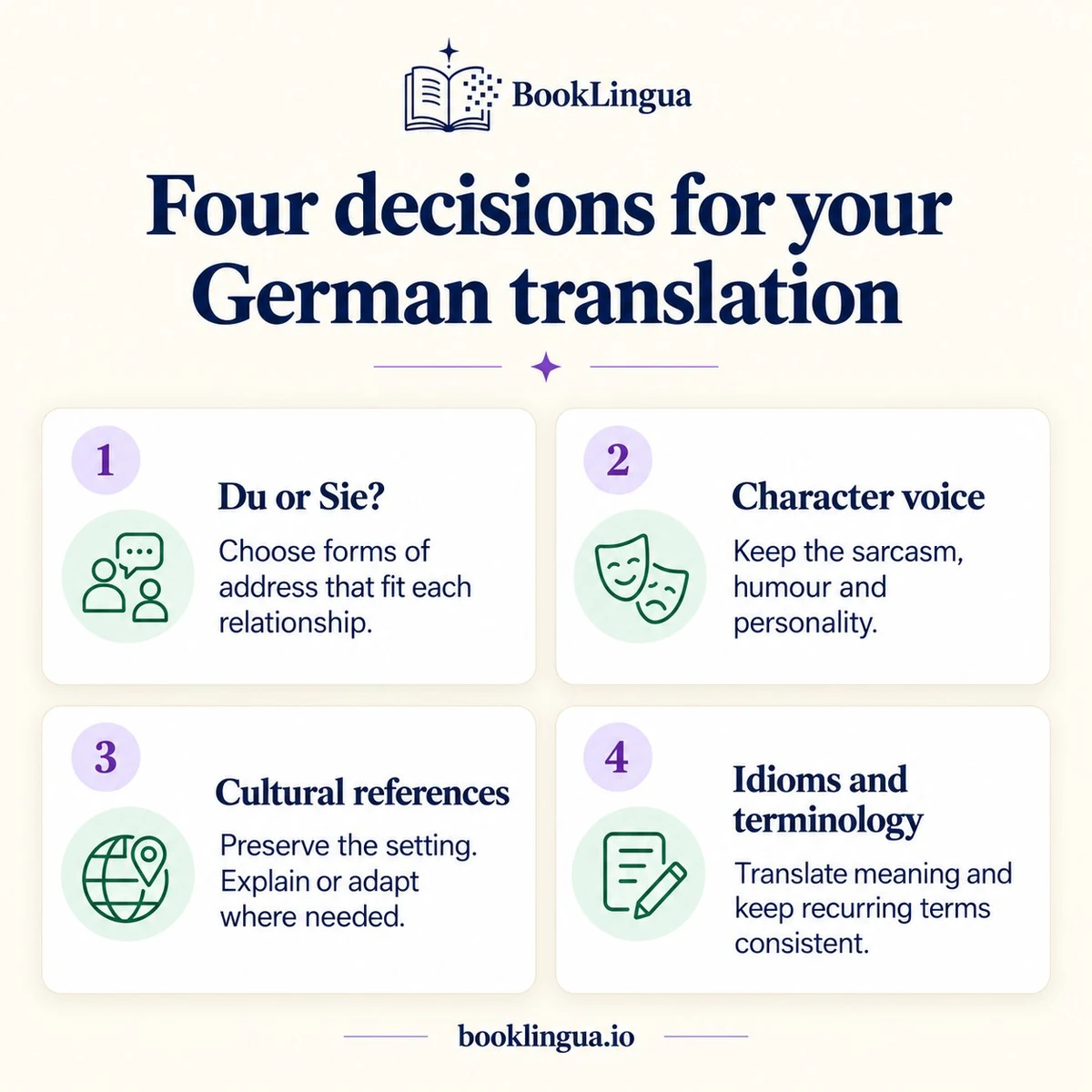
For German, these are the choices I’d make sure the brief covers.
Decide how characters use du and Sie
English “you” does not tell a translator whether a character is using an informal or formal form of address. German often requires that decision.
The right choice depends on the relationship, setting and scene. Two strangers, a manager and employee, or characters in a historical novel may need different treatment.
This is particularly interesting in romance. A move from “Sie” to “du” can say something about two characters getting closer. You need to decide where that shift belongs in the story, rather than leave each chapter to make its own guess.
Describe each character’s voice
This is one area where it pays to be specific. What makes each character sound like themselves?
“The heroine uses dry humour and short replies” is more helpful than “make her sound engaging”. The same applies to a formal narrator, a blunt detective or a villain whose politeness is part of the threat.
For example, if you have a sarcastic heroine you want her to stay sarcastic in German. She shouldn’t come out the other end sounding like she’s politely helping someone reset their password.
Explain what should stay culturally specific
Just because you're translating the story doesn’t mean you need to relocate the entire cast to Berlin.
A novel set in Yorkshire can keep its setting, institutions and local references. The question is whether readers need a natural equivalent, a little context or the original term.
Record decisions about school systems, job titles, measurements and recurring references. A historical setting may need a different approach from a modern practical guide.
Flag idioms and invented terminology
Expressions such as “you’re pulling my leg” need their intended meaning carried across. Translating the individual words may lose the joke.
Fantasy terminology needs similar care. Decide which invented names stay unchanged and which descriptive terms should be translated. Keep those choices in a glossary so the same kingdom or magical order does not acquire three names.
Review the German translation
I always think of the first translation as a draft. Getting to the end of it is a big step, but there’s still checking to do.
There are two different questions to answer: does the German read naturally, and does it still say what the English says?
The tricky mistakes aren’t always the sentences that sound awkward. A sentence can read beautifully and still change what a character meant, soften a threat or get an important detail backwards. That’s why I’d look beyond grammar.
Check for missing or repeated passages, inconsistent terminology, changes in meaning, awkward dialogue and shifts in character voice. For German, also pay attention to forms of address, sentence rhythm and the punctuation style used for dialogue.
If you don’t speak German, there’s still plenty you can check yourself: chapter counts, headings, scene breaks and whether the files open properly. For the language itself, you’ll need someone who can compare the German with your English manuscript.
A sample review can flag problems and give you useful feedback. It won’t tell you what’s happening on every page that hasn’t been reviewed, though. Choose the level of human review with your book’s complexity, budget and the consequences of an error in mind.
Technical or specialist nonfiction may also need a reviewer with subject expertise.
Localise the title and book description
Once the manuscript is ready, you need to give the title and description proper attention. They’re what readers will see before they’ve read a single page of your story.
A title that works in English may feel awkward when translated literally. Ask a German-speaking reviewer to assess possible titles for meaning, tone and genre fit, then consider how the chosen wording will look on the cover.
With the description, I’d focus on keeping the hook and the feeling that makes someone want to read on. Give the German wording room to sound natural, while making sure readers can still recognise the central conflict, atmosphere and kind of book they’re buying.
Research keywords using German-language books and searches in your genre. A literal translation of an English keyword is a starting point, not evidence that German readers use it.
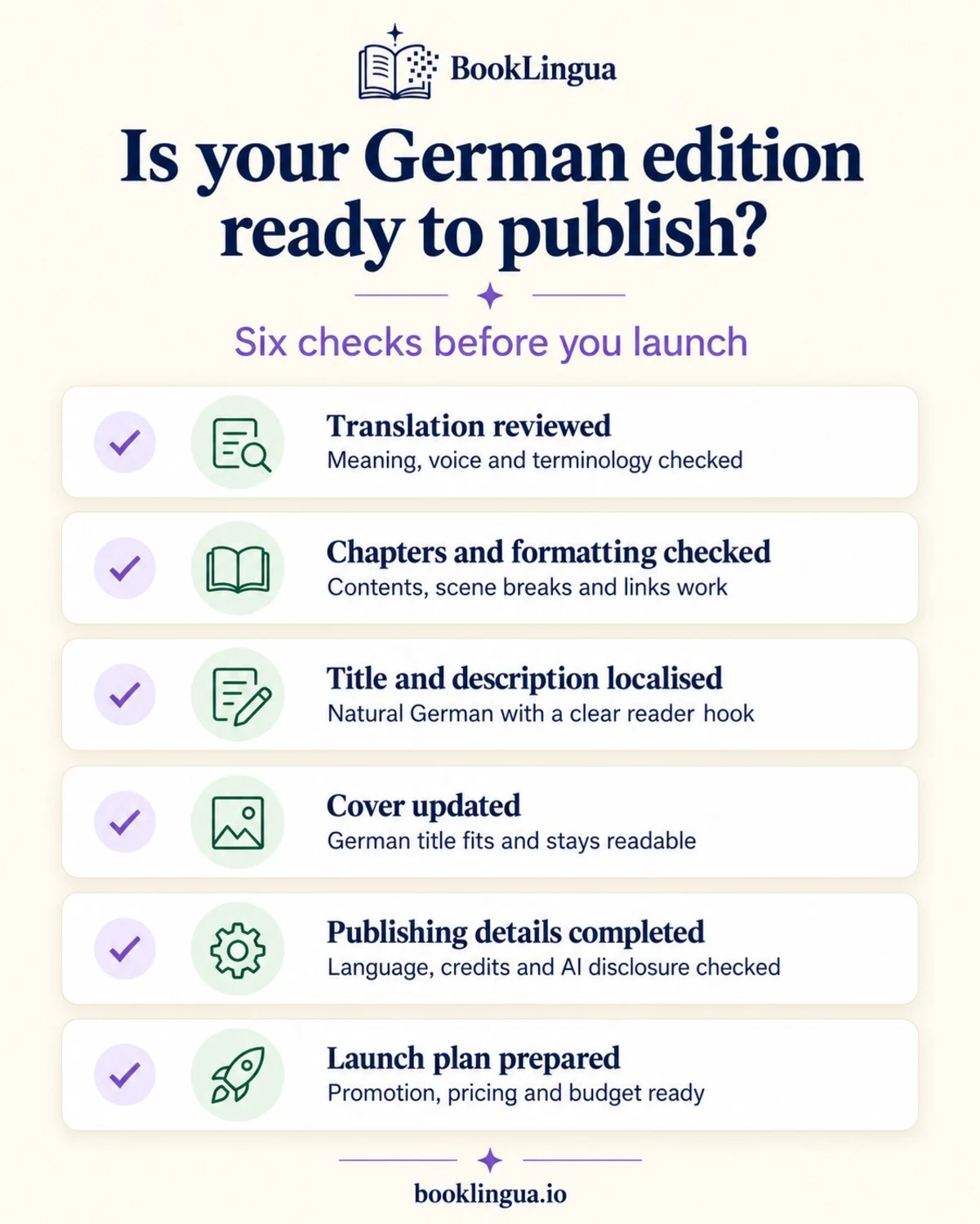
Review your cover too. The German title may need different spacing or line breaks. For print editions, use the final interior to establish the page count before completing the spine.
Prepare the German edition for publication
Before you upload, open the finished ebook and have a proper look through it. It’s a small job compared with writing a book, and well worth doing.
Check the contents page, chapter order, scene breaks, italics, links and German characters such as ä, ö, ü and ß. Translate relevant front and back matter as well as the main text.
When publishing through KDP, accurately identify the book’s language and follow Amazon’s current requirements for translated works and contributor credits.
KDP requires disclosure of AI-generated translations. If AI created the translation, substantial human editing afterwards does not change that classification. Check the current KDP Content Guidelines when preparing your upload.
Then give the German edition a launch plan: a clear description, places to promote it and a budget you’re comfortable testing. Getting the book onto Amazon is a milestone. You still need to help readers discover it.
How much does English to German book translation cost
I recommend starting with a quote for your actual manuscript and the amount of review you want. A headline price only helps if you know what it includes.
Compare translation, editing, proofreading, formatting, cover changes and launch materials. Ask what revisions are included and what happens if you discover a problem after delivery.
For BookLingua, you can use our free price calculator to estimate your project. If you want additional human editing or proofreading, include that in your overall budget.
I’d ask the same sort of question about timing: when will I have the checked files ready to publish? A quick first draft is useful, but you’ll want to know when the rest of the work will be finished too.
Questions authors often ask
Can AI translate an entire book from English to German
Yes, AI can generate a full German draft. A complete book still needs a workflow that maintains context and terminology across chapters and checks the result before publication.
Do I need to speak German to publish a German edition
No, but you need a reliable way to assess the language. You can inspect structure and formatting yourself; a qualified German-speaking reviewer can assess meaning, voice and natural phrasing.
Should I translate my whole series at once
You can, but I would usually start with the first book if you have not tested the market. Prepare a series glossary from the beginning and use what you learn from the first launch to plan later editions.
Can I publish an AI translated German book on Amazon
KDP provides for AI-generated translations under its content guidelines. You must disclose the AI use, hold the necessary rights and meet its content and quality requirements.
Start your English to German translation
My advice is to keep the first steps simple: get your manuscript ready, write a useful brief and choose a process you’re comfortable with. Make sure you understand what’s being reviewed, check the files and give the German edition a launch plan of its own.
If you are considering a German edition, get an estimate with BookLingua’s free price calculator.
You’ve already done the hard work of writing the book. A German edition gives that story another chance to find its readers. I think that’s a pretty exciting reason to get started.