How to Market a Translated Book When You Don’t Speak the Language
Learn how to market a translated book without speaking the language, from localised descriptions and Amazon keywords to promotions and reader communication.

Written by Teddy Smith
BookLingua founder, author and host of The Publishing Performance Show
Once you’ve translated your book into a foreign language, sooner or later you have to ask yourself how to market a translated book when you don’t speak the language.
I ran into this issue myself when I published the German edition of Bride of the Hollow King, I could upload the book to Amazon, but I wasn’t suddenly qualified to write a persuasive German advert. My language skills hadn’t improved quite as quickly as my publishing ambitions!
The good news is that you don’t need to become fluent in a new language in order to market your book. Understanding your readers, presenting the story well and finding ways to get it in front of them requires the same skills across all languages. You'll just need some help checking the language and getting to know the local market.
In this guide, I’ll walk through how to do that, from preparing your book description to testing promotions and answering readers when they get in touch.
Table of Contents
- 1. Start with one language and one main market
- 2. Research comparable books in the local store
- 3. Get your book description checked before buying traffic
- 4. Choose keywords readers actually use
- 5. Prepare a small set of approved marketing materials
- 6. Test one discovery channel first
- 7. Make reader communication manageable
- 8. Measure results against your earnings
- A manageable launch plan
- Ready to introduce your book to new readers?
1. Start with one language and one main market
It’s tempting to picture your book reaching readers everywhere at once. But each new market needs its own description, cover, set of keywords and launch campaign to manage.
So start with one translated edition and a clear audience. For example, rather than planning to market your book to all German readers, make the task more specific e.g. market your romantasy novella to German readers who enjoy dark fairy-tale settings and morally complicated love interests.
That gives your research a direction. Which books are those readers buying? How are they presented? Where do readers discover them?
A language and a country aren’t interchangeable. Spanish-language readers, for example, live in several markets with different buying habits and retail options. Choose where you’ll concentrate your first efforts, while keeping the edition accessible to other readers where possible.
If you’re still deciding where to begin, read Which Language Should You Translate Your Book Into?.
2. Research comparable books in the local store
Your existing English-language marketing gives you a starting point, but it doesn’t tell you everything about another market.
Look at comparable books in the store where you plan to sell. Choose titles that match your genre, tone, audience and format, rather than simply collecting the biggest bestsellers.
Pay attention to:
-
Covers: imagery, typography and the signals that identify the genre.
-
Descriptions: opening hooks, length and how they introduce the story.
-
Positioning: tropes, themes and reader expectations.
-
Pricing: comparable ebook and paperback prices.
-
Reader feedback: what reviewers praise and what disappoints them.
You can use your browser’s translation feature to read book descriptions and reviews in English. Look for recurring themes, tropes and selling points. If you find a phrase you want to use in your own marketing, ask someone fluent in the language to check that it sounds natural and fits your book.
If several successful books use a term you don’t recognise, find out what it means before adding it to your own copy. You don’t want to end up promising something your book doesn’t deliver.
3. Get your book description checked before buying traffic
Your description is one of the most valuable pieces of marketing copy you have, so make sure you give it some proper attention.
A literal translation can preserve the meaning while losing the hook, for example the humour might sound awkward or the romantic trope might sound odd to local readers.
If you can, I recommend asking a professional translator or editor who understands the genre to review the copy for the intended audience.
Give them a clear brief covering:
-
Who is the book for?
-
What are its main tropes or themes?
-
What tone should the description convey?
-
What promises must it avoid?
-
Which details must remain accurate?
For romance, that might include the heat level, the type of relationship and whether the story ends with a happily ever after.
Translating your description back into English can help you spot changes in meaning, but it won’t tell you whether the translated version sounds natural or makes someone want to read the book. For that, you need to ask someone fluent in the language to check it.
It’s important to start with your title, subtitle, book description and any text on the cover. Get those right before spending time or money on lots of social posts, because they’re the words readers see when deciding whether to buy.
4. Choose keywords readers actually use
Keywords are words or short phrases that help readers find your book. When you publish through Kindle Direct Publishing (KDP), Amazon’s self-publishing platform, you can enter these in the keyword fields during setup.
For the full listing process, see How to Publish a Translated Book on Amazon KDP.
Think about what someone might type into Amazon when looking for a story like yours. For a romance novel, that could include its setting, relationship tropes or type of main character e.g. “small-town romance”.
Start by listing those features in English. Then get help finding the phrases readers use in your target language. Simply translating “small-town romance” word for word might miss the expression local readers recognise.
To check a potential phrase, visit the Amazon store where you plan to promote the book, such as Amazon.de for Germany. Type it into the search bar and look at the suggested searches. Then run the search and see what books appear. Are they similar to yours? If the results are mostly unrelated, the phrase may need adjusting.
Amazon recommends choosing keywords that accurately describe your book and reflect how readers search. Search suggestions can give you ideas, but they don’t tell you exactly how popular a phrase is.
Listing keywords and advertising targets do different jobs
Listing keywords are the terms you enter when setting up your book. They help Amazon understand which searches your book may be relevant to.
Advertising targets are the keywords, books or categories you choose when running a paid Amazon advertising campaign. They help determine where your ads may appear.
For example, you might use a relevant phrase for “small-town romance” in your listing keywords. Separately, you could target a comparable romance novel with an advert to try to reach its readers.
Amazon doesn’t allow other authors’ names in your listing keywords. Instead, choose terms that describe your own book’s genre, setting, characters and themes. You can still use comparable books as targets in an Amazon advertising campaign to try to reach readers who might enjoy yours.
Check your categories too
Categories are the sections of Amazon’s bookshop where readers browse, such as romance, fantasy or historical fiction.
When setting up your translated edition, check the available categories and choose those that genuinely fit the story. Don’t assume the options will be identical to those for your English edition. If a category label is unfamiliar, get help understanding it before selecting it.
5. Prepare a small set of approved marketing materials
You don’t need to create new marketing copy every time you promote the book.
Create materials you can reuse such as:
-
A full book description.
-
A short description for promotions.
-
Two or three hooks.
-
A brief author biography.
-
A few social captions.
-
An outreach email for reviewers or promotion partners.
-
The cover and correct retailer links.
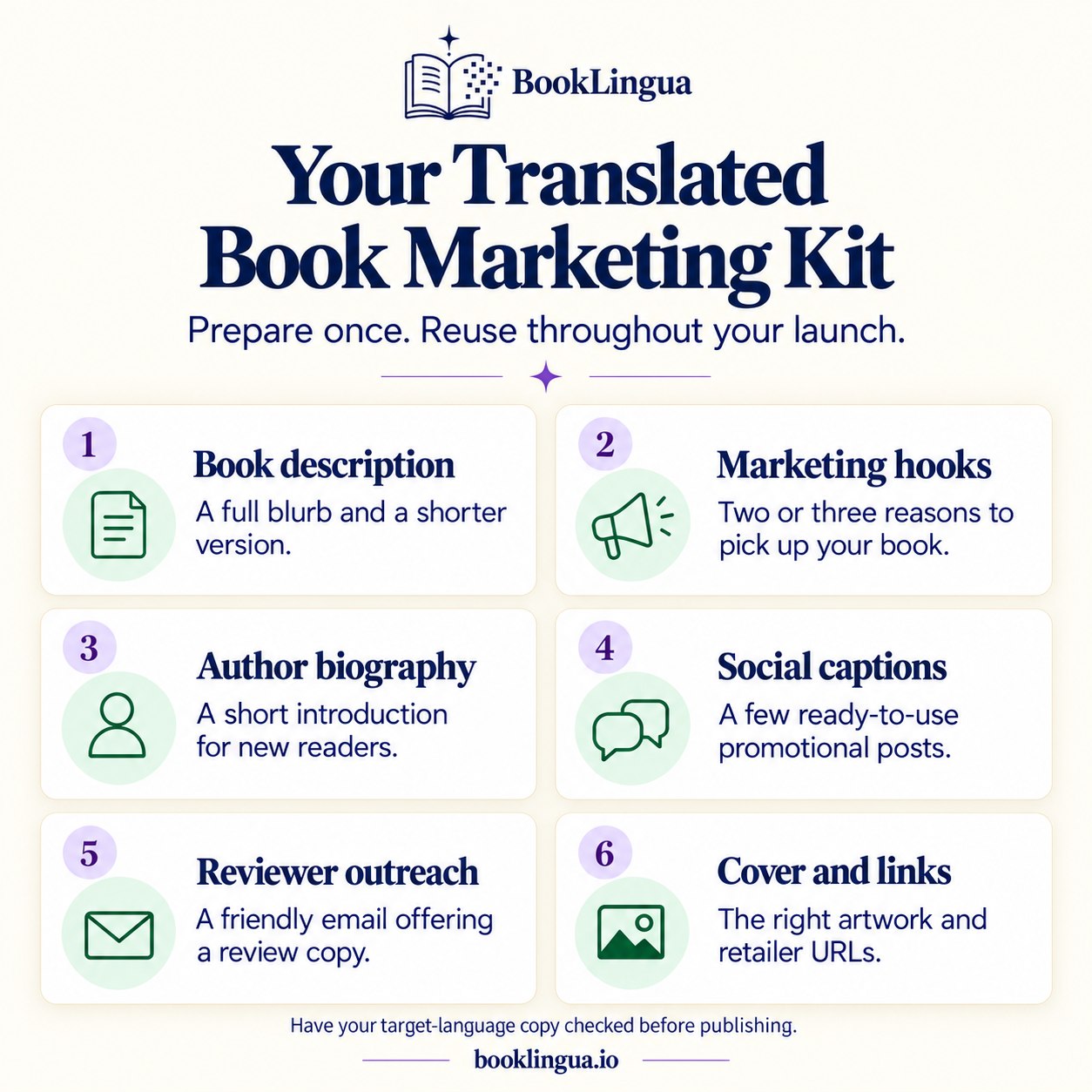
Prepare these core marketing materials once, then reuse them throughout your launch.
I keep an English version alongside my translated marketing copy so I know what I’m publishing. Once the translated wording has been checked, I reuse it rather than starting from scratch each time. If I make substantial changes, I get those checked too.
At BookLingua, localised launch materials are part of the delivery package, so you have a solid starting point for publishing and promotion.
You can see exactly what’s included in Understanding Your BookLingua Delivery Package.
6. Test one discovery channel first
You don’t need a translated website, a daily posting schedule and five advertising campaigns to get started. Just choose one main way to reach readers and run a manageable test.
Amazon advertising
Amazon Sponsored Products offers automatic targeting, keyword targeting and product targeting. Product targeting lets you select relevant books or genres, which can be useful when you’ve identified comparable titles but are still learning local search terminology.
Start with a limited test budget and a clear spending cap. Confirm that your edition is available and eligible in the marketplace where you plan to advertise.
Amazon also has language requirements for advertising, including additional conditions when the book’s language differs from the language of the Amazon site. Check those before setting up the campaign.
Local book promotion services
A newsletter or book promotion service with an established local readership can give you access to readers without you having to build that audience yourself.
Before booking, ask about genre fit, audience location, eligibility requirements, cost and reporting. A large subscriber count is less useful than an audience interested in books like yours.
Reviewers and creators
Look for reviewers, bloggers and creators who already talk about books like yours in the target language. Send them a short introduction explaining what your book is about and why it might interest their audience, and offer a review copy if you can.
Keep it friendly and pressure-free: you’re inviting an honest review, not asking for a glowing recommendation.
Give your chosen marketing channel enough time and attention to learn whether it works for your book. Keep track of what you spend and the results you get, then use that information to decide whether to continue, adjust your approach or try another channel.
7. Make reader communication manageable
What happens when a reader emails you in German or leaves a question in Spanish? You don’t need to panic or sign up for an intensive language course! With a little preparation, you can handle most everyday messages.
Start by having a few reusable replies translated and checked. These might cover:
-
Thanking someone for reading your book.
-
Sharing a link to where they can buy it.
-
Giving an update on the next book in the series.
-
Thanking someone for flagging a typo or formatting problem.
For other straightforward messages, AI translation can help you understand what the reader is asking and draft a response. Translate your reply back into English before sending it to check that it says what you intended.
If the message involves a complaint, a sensitive subject or wording you’re unsure about, get someone fluent to check your response. Those are the conversations where a small misunderstanding can make things harder.
You can also be open about using translation tools. Readers are getting a reply from the person who wrote the book, and you don’t need to pretend you speak their language fluently.
If you invite readers to join your email list, make it clear which language you’ll use. Someone signing up for updates about your German edition should know whether those updates will arrive in German or English.
8. Measure results against your earnings
Clicks and attention are useful signals, but they don’t automatically mean your launch is paying for itself.
I recommend tracking:
-
Advertising and promotion spend.
-
Sales of the translated edition.
-
Royalties earned.
-
Kindle Unlimited reading revenue, if applicable.
-
Email signups.
-
Recurring comments about the description or translation.
Compare your spending with what you actually earn, rather than the book’s retail price. For example, if a promotion costs €50 and you earn €2 in royalties per sale, you would need 25 additional sales to recover that spend, before allowing for other costs.
If readers click but don’t buy, review the product page, price and audience fit. Avoid changing everything after a handful of clicks: give the test enough time to gather useful data and look for patterns before making big marketing changes.
Reader reports about language problems are different. Investigate those promptly, especially if several people flag the same issue.
A manageable launch plan
For your first translated edition, here’s my simple seven-step launch plan:
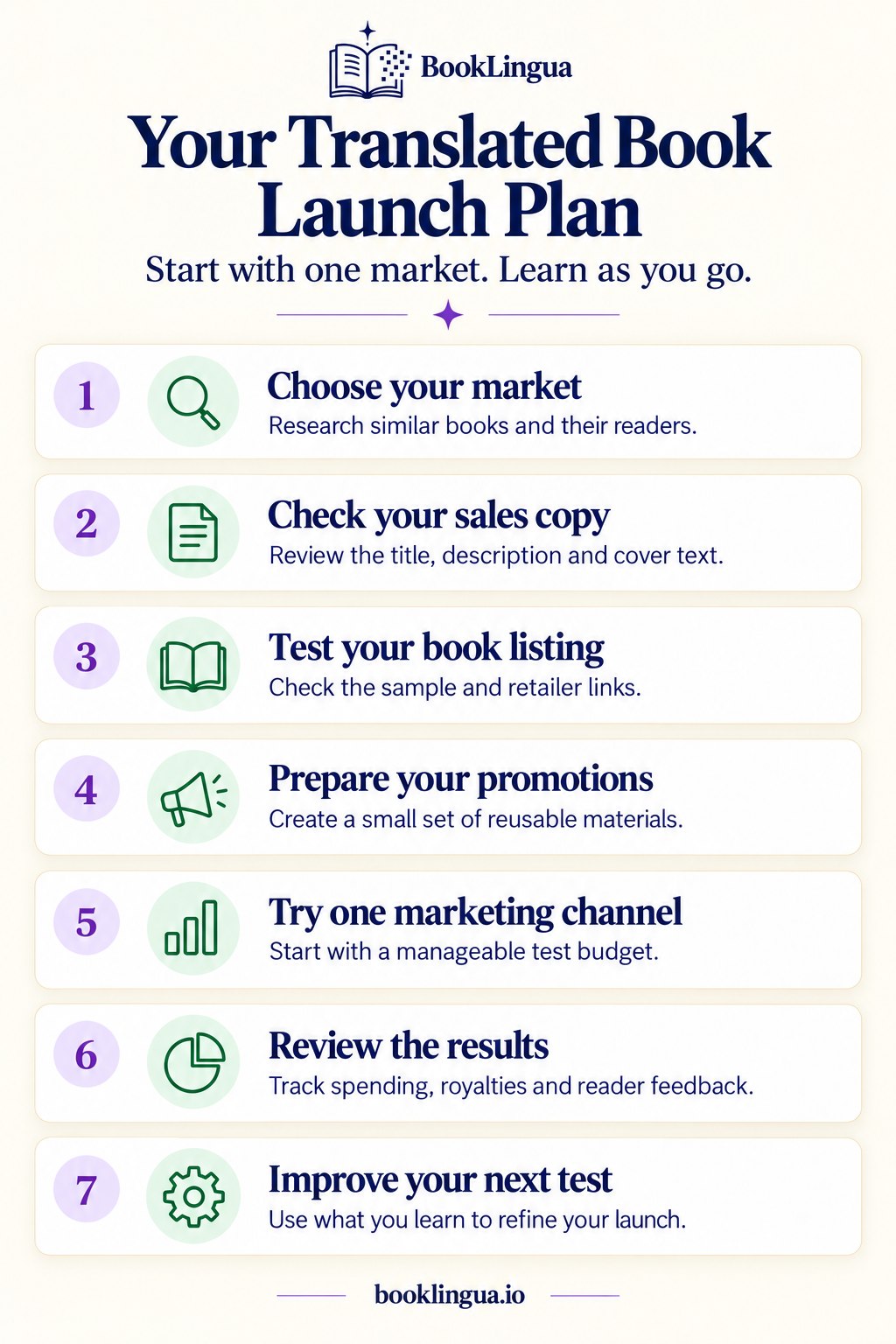
Start with one market, test one channel and improve the next launch using what you learn.
-
Research comparable books in one main market.
-
Have the title, description and cover text checked.
-
Confirm the listing, sample and retailer links work.
-
Prepare a small set of reusable promotional materials.
-
Test one discovery channel.
-
Review spending, sales and reader feedback.
-
Improve the next test using what you’ve learned.
When I published the German edition of Bride of the Hollow King, getting the ebook onto Amazon was just one part of the process. A launch plan gives you a clear next step: finding readers who might enjoy it.
Ready to introduce your book to new readers?
You don’t need to speak every language your readers speak. You do need a book you’re confident in, checked marketing copy and a willingness to learn what works in your new market.
BookLingua combines AI manuscript translation with a separate editorial pass, consistency checks, Targeted Professional Translator Review of selected passages and localised launch materials.
If you’re considering your first translated edition, use the BookLingua price calculator to get an estimate for your manuscript.