How to Translate Your Book into Spanish
Learn how to translate your book into Spanish, choose Spain or Latin American Spanish, review the manuscript and prepare your translated edition for launch.

Written by Teddy Smith
BookLingua founder, author and host of The Publishing Performance Show
Expanding your book into Spanish is a huge opportunity, but from my experience, it takes more than just a great translation to succeed.
Whether you're aiming for readers in Spain or across Latin America, you'll want to lock down a few essentials first, including a culturally tuned title, a compelling blurb, and a solid launch plan.
Treating your Spanish edition like a brand-new publishing project makes all the difference. Here is how I would approach it…
1. Research whether Spanish is a good fit for your book
With over 600 million Spanish speakers worldwide and a booming digital book market across Spain and Latin America, it’s easy to see why expanding into Spanish is such an appealing move.
A massive potential audience is exciting, but it doesn't automatically tell you how well your specific book will sell.
To figure that out, start by looking at books similar to yours. Look for Spanish-language titles in your genre, including books originally written in Spanish and successful translated editions and compare the promises they make to readers.
For a romance novel, that means looking closely at your subgenre, relationship tropes, heat level, and cover style. For nonfiction, look at the core problem the book solves and whether the advice translates naturally to readers in those markets.
Romance authors may also find our guide to translating romance novels without losing the chemistry useful when evaluating genre expectations in another language.
Make a short list of comparable books and note:
-
How their titles and descriptions position them.
-
What their covers signal about the genre.
-
Their ebook and paperback price points.
-
What readers praise or criticize in reviews.
-
Where you could realistically promote a similar book.
Use your research to judge whether you can position your book clearly. A strong bestseller rank or a busy review section is a helpful clue, but neither gives you a guaranteed sales forecast on its own.
From there, you'll also want to think strategically about which book to translate first. A well-reviewed standalone can be a low-risk starting point. The first book in a series offers fantastic potential for repeat purchases, but you’ll want to have a realistic plan in place for translating the rest of the series if readers come back asking for more.
2. Choose Spanish for Spain or Latin America
Simply saying "translate it into Spanish" is just a starting point. Your brief needs to be a bit more specific.
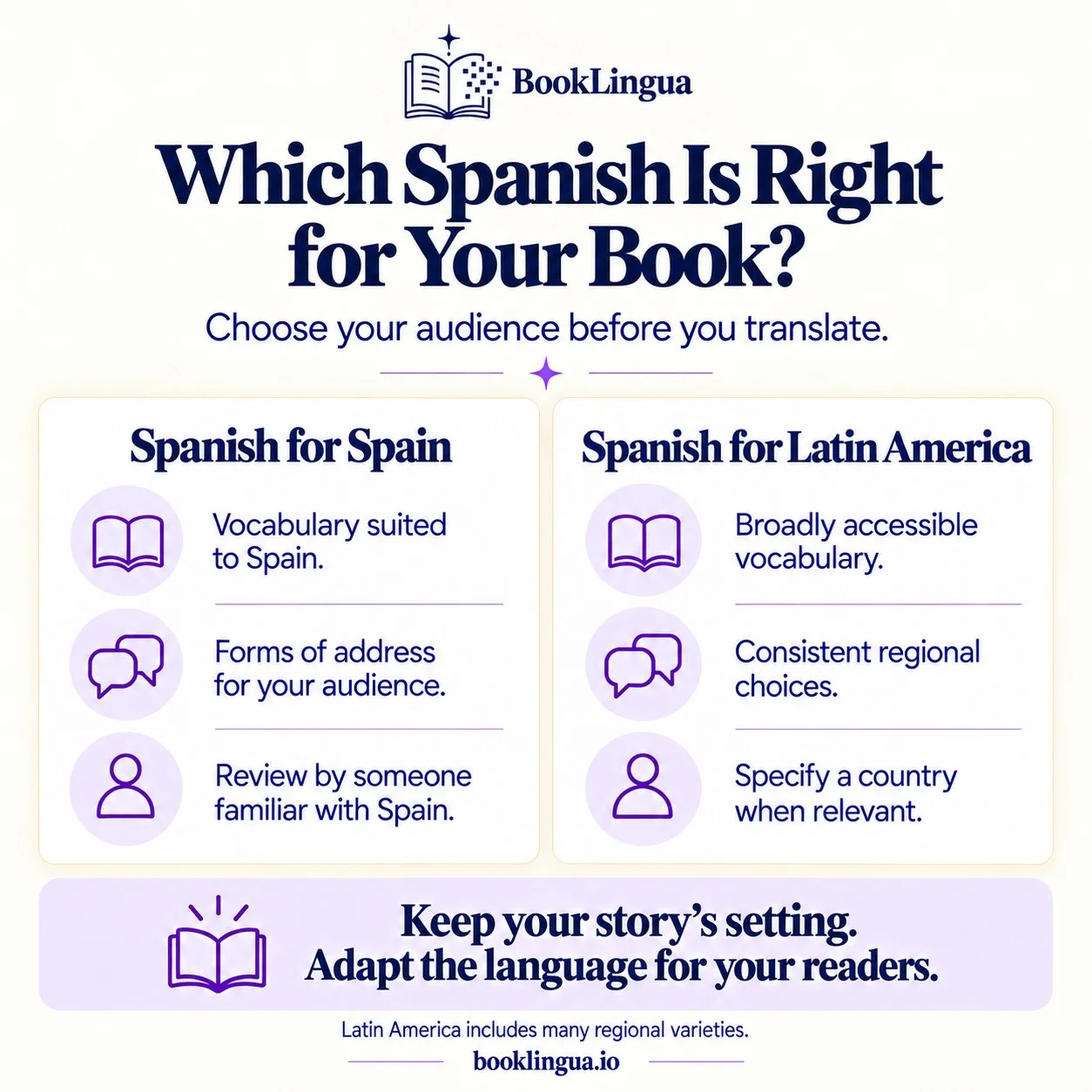
Spanish varies heavily between regions. While readers can usually understand different varieties, vocabulary, forms of address, and local nuances deeply affect how natural a book feels.
For instance, a computer is an ordenador in Spain, but a computadora across much of Latin America. Informal plural dialogue might lean on vosotros in Spain, while Latin America relies entirely on ustedes. Even individual countries have their own unique preferences.
| Intended audience | Direction for your translation brief |
|---|---|
| Primarily readers in Spain | Request Spanish for Spain, with suitable vocabulary and forms of address. |
| A broad Latin American audience | Request broadly accessible Latin American Spanish and define how regional slang should be handled. |
| Readers in a particular country | Specify the country and discuss any local language choices with your translator or reviewer. |
Latin America isn’t one uniform language market, either. Even with a broadly accessible edition, you still need to make consistent choices when it comes to dialogue and vocabulary.
Choosing a specific language variety doesn't mean you have to relocate your story, though. A romance set in London can stay right there in London in any version. The real goal is simply making the language feel natural and accessible to your readers while keeping the unique world you created completely intact.
At BookLingua, we offer both Spanish for Spain and Spanish for Latin America so you can easily choose the option that fits the exact readers you plan to reach.
3. Prepare your English manuscript
I always recommend translating a fully edited manuscript that you're entirely happy with.
If you rewrite scenes after translation, those changes have to be tracked and carried over into the Spanish version, which creates extra work and opens the door for inconsistencies.
Before sending your files over, it helps to do a quick final check to make sure. For a fuller walkthrough, see our manuscript preparation guide:
-
Chapters are in the correct order.
-
Headings follow a consistent structure.
-
Character names and important terms are locked down.
-
All comments, tracked changes, and drafting notes are cleared out.
-
Front and back matter contain the exact information you want translated.
-
Any text trapped inside images has been identified separately.
For formatting, DOCX is my preferred starting point because it keeps the manuscript structure clean and easy to work with, though EPUB and TXT are fully supported too.
Above all, make sure to keep a dated copy of your source manuscript. You’ll want to be able to look back and identify exactly which English version your Spanish edition was translated from.
4. Write a translation brief that protects your voice
A good translation brief explains the choices a translator can't safely guess from the words alone.
Make sure to include your target Spanish variety, your genre, your intended readership, and the overall tone you want to preserve. It helps to note whether your prose is spare or elaborate, if your humor is dry, and how formal or informal your characters sound.
For fiction, I always recommend including:
-
Character names, relationships, and distinctive speech patterns.
-
Recurring nicknames and terms of affection.
-
Invented places, magical terms, and series-specific terminology.
-
Your preferred treatment for profanity and intimate scenes.
-
Cultural references, jokes, and wordplay that need careful handling.
For nonfiction, focus instead on specialist terminology, the reader’s assumed level of knowledge, and any examples tied to a specific country.
Your brief doesn't need to be complicated. Our step-by-step AI translation guide explains this in more detail. It might look something like this:
Use Spanish for Spain. Preserve the contemporary British setting and the narrator’s dry humor. Keep character and place names unchanged. Dialogue should feel natural without adding slang that shifts a character’s personality. Flag any jokes or idioms that might need a more substantial adaptation.
That last instruction really matters. Translating an idiom often requires a completely different local expression to preserve its original meaning, and you'll want to stay in the loop whenever a decision changes the feel of a passage.
5. Choose a translation process with a clear review scope
When it comes to getting the job done, you have a few paths: you can work with a human literary translator, handle the AI translation yourself, or choose a service that combines AI translation with thorough editorial work and professional human input (like BookLingua). It is also worth understanding why editorial review matters in AI book translation.
The right choice really comes down to your budget, how complex your book is, and how hands-on you want to be.
When you're comparing options, it pays to ask a few key questions:
-
Who is actually creating the translation?
-
Who reviews it, and how much of the manuscript do they check?
-
What happens if the reviewer flags a problem?
-
Which exact files do you receive at the end?
A polished sample is nice to see, but it can't prove that every single chapter is complete or that your recurring terms stay consistent from the first page to the last.
To see what a translated manuscript, editorial review and launch materials look like together, explore our AI book translation case study or browse the BookLingua translation examples.
At BookLingua, we use a smart hybrid approach: we combine a cultural scan, full manuscript AI translation, a separate AI editorial pass, rigorous consistency checks, and a Targeted Professional Translator Review. Our professional translators focus on selected passages that require special care and cultural nuance, rather than doing a full line-by-line human proofread. You can see how the full BookLingua process works.
Of course, if you want a second set of human eyes on literally every single line, just make sure to build that into the scope when choosing your service or commissioning an extra round of review.
6. Review meaning, dialogue and consistency
A Spanish translation can sound completely fluent on the surface while still shifting a detail that actually matters.
A playful teasing remark from a character might accidentally read as hostile, a term of affection could end up feeling way too formal, or an invented term might drift halfway through the story. In nonfiction, even a small shift in wording can subtly alter an instruction.
I always recommend paying particular attention to:
-
Meaning: Are key events, relationships, and instructions accurately preserved?
-
Voice: Does the narrator keep their intended tone and personality?
-
Dialogue: Do characters sound distinct, and are forms of address used consistently?
-
Regional language: Does the vocabulary genuinely fit your chosen Spanish market?
-
Terminology: Are names and recurring terms completely consistent from start to finish?
-
Completeness: Are all chapters, plus your front and back matter, fully present?
If you don't speak Spanish yourself, it's smart to ask for feedback from a qualified translator or editor who specializes in your chosen regional variety. Make sure to give them both your original brief and the relevant English passages so they can easily compare the intended meaning against the final Spanish wording.
And while running a translated text back through an automated tool to re-translate it into English can sometimes flag oddities, it’s worth noting that it can't reliably tell you whether the Spanish sounds natural or preserves all your subtle nuances.
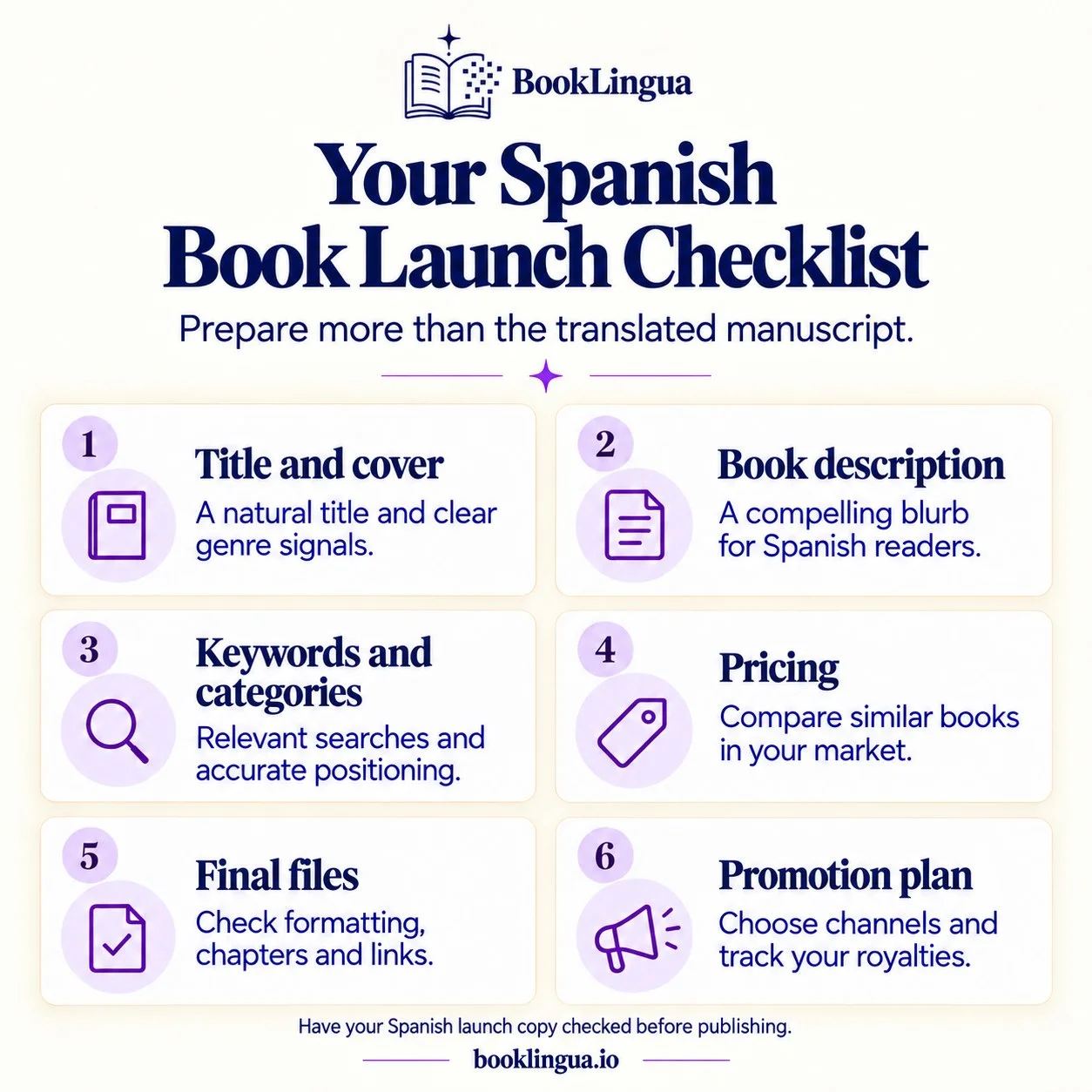
7. Prepare your Spanish title and book description
Your manuscript is really only one part of the whole edition.
Your title, cover wording, and description need to immediately help Spanish-speaking readers recognize the exact kind of book you’re offering. Sometimes a literal translation of your English title works like a charm, but other times it completely loses its hook.
Before giving a title the green light, ask yourself: Does it sound natural? Does it clearly signal the genre? And does it play well with the cover? If you're writing a series, you'll also want to lock down a naming convention you can easily stick to for all the books down the line.
When it comes to your Spanish description, it has to sell the premise, the stakes, and the overall appeal.
You’ll want to get all your other launch details sorted out, too:
-
Subtitles and series names, wherever relevant.
-
Cover text and your author biography.
-
Keywords built on actual Spanish-language search habits.
-
Categories that genuinely fit your genre.
-
Pricing informed by what comparable editions are doing in that market.
-
A dedicated Spanish reader signup page, if you're building your mailing list overseas.
Above all, try not to assume that every English keyword or marketing angle will magically perform the same way after translation. Local search behavior matters!
8. Format and check the Spanish edition
Text length and line breaks can shift during translation, so it’s always best to check your final files rather than assuming the English layout will carry over perfectly.
Take a close look at things like chapter headings, your contents page, italics, paragraph breaks, dialogue punctuation, and special characters. It’s also smart to double-check that all links lead to the right destinations and that no lingering English drafting notes made it into the final document.
If you're publishing a paperback, you'll want to pay extra attention to page breaks, running headers, and the cover. A change in overall page count directly affects the spine width, after all!
Finally, when you're ready to publish through Amazon KDP, make sure to answer their AI-content questions accurately. KDP requires clear disclosure for any AI-generated translations, even if you substantially edited the text afterward. It's always a good idea to review Amazon’s current content guidelines to stay fully up to date on their definitions and contributor requirements.
9. Plan how you will reach Spanish-speaking readers
Publishing your new edition gives readers a place to buy it, but you still have to help them actually discover it.
Start by picking a manageable first audience and a small, focused number of promotional channels. Depending on your book, that might include Spanish-language reviewers, dedicated genre communities, newsletters, or targeted advertising aimed straight at your ideal readers.
If you don't speak Spanish yourself, make sure you have pre-approved promotional copy ready to go, and arrange for a bit of help with customer replies that go beyond a simple "thank you." It's also smart to keep your initial marketing budget modest so you can test the waters and learn from the response before diving in deeper.
Always track your royalties right alongside your upfront expenses including translation, cover design, formatting, and marketing costs.
To put it in perspective: if your edition costs €500 to prepare and you net an average of €2 per sale, you'll need 250 sales just to break even on that initial investment. Keep in mind that ad spend will raise that threshold, too. Always base your math on your actual costs and expected net royalties rather than just looking at the retail price.
Finally, remember that a new foreign-language edition can take time to find its rhythm and audience. Give yourself a simple way to track what’s working so you can tweak your product page or promotion whenever things need a boost.
Start with a clear audience and a clear plan
If you are considering translating your book into Spanish, I would begin with three core decisions: which readers you want to reach, which book to translate first, and what level of review you need.
From there, you can prep your manuscript, lock down your language choices, and build a targeted launch around your finished edition.
At BookLingua, we can help you translate your manuscript and prepare fully localized launch materials. You can use the BookLingua pricing calculator to get an instant estimate based on your word count and chosen Spanish option.
Frequently Asked Questions
Should I choose Spanish for Spain or Latin America?
Choose based on your intended readers and launch strategy. Spanish for Spain is a natural fit if your launch is focused there. For a broader Latin American audience, you'll want to agree on a consistent approach to vocabulary and regional expressions. If you have a specific country in mind, make sure to spell that out in your brief.
Can I translate my book into Spanish with AI?
AI is great for generating a draft translation, but the output still needs a thorough check for meaning, voice, consistency, and completeness. Always understand the review scope before treating an AI-assisted manuscript as ready to publish.
Can I publish a Spanish edition if I do not speak Spanish?
Yes, absolutely, many authors do! However, you will need language support to evaluate the translation and help prep reader-facing copy. It's best to arrange that support before you publish, and have a plan for how you'll handle reader questions or reviews afterward.
How much does it cost to translate a book into Spanish?
The total cost depends on your manuscript's length, the translation workflow, and the amount of editorial and human review included. Make sure you're comparing apples-to-apples when looking at quotes, and don't forget to budget for your cover, formatting, and launch costs right alongside the manuscript.
Do I need separate editions for Spain and Latin America?
Not automatically. Spanish readers are generally very flexible and can easily understand different regional varieties. It's usually smartest to start with your primary target audience and see if one well-crafted edition meets your goals before investing in a second separate version.