How to Translate a Book with AI: A Step-by-Step Guide
A complete guide to translating a book with AI, from manuscript preparation and translation briefs to validation, editing, localisation and launch.

Written by Teddy Smith
BookLingua founder, author and host of The Publishing Performance Show
Table of Contents
- How do you translate a book with AI?
- Can AI translate an entire book?
- Stage 1: Prepare
- Stage 2: Translate
- Stage 3: Validate
- Stage 4: Edit
- Stage 5: Localise
- Should you translate your own book with AI?
- Is AI book translation good enough to publish?
- AI book translation checklist
- How BookLingua helps authors translate their books
- Frequently asked questions
- How long does it take to translate a book with AI?
- Can I translate a book using ChatGPT?
- Do I need a human translator after using AI?
- Can AI preserve an author's voice?
- Can AI translate fiction?
- Can I translate only the first book in a series?
- Do I need a new ISBN for a translated book?
- Should I change the cover for a translated edition?
- Does a translated book need different keywords?
- Can I publish a translated book outside Amazon?
AI has changed what is possible for authors who want to take their books into new markets.
Until recently, translating a full-length novel usually meant investing a substantial amount of money and waiting months for the finished manuscript. For many independent authors, that made international publishing hard to justify, especially when there was no guarantee the new edition would earn back its costs.
AI can now produce an initial manuscript translation much faster and at a far lower cost. That opens up exciting possibilities, but it does not mean you can upload your manuscript, accept the first output and publish it on Amazon.
The key thing to understand is that translated text is not the same as a publication-ready translated book.
If you are still planning the project, start by choosing the right target language, preparing the manuscript and creating a clear translation brief. Those decisions shape every later stage.
A finished edition needs to preserve your meaning, story, tone and voice. Every chapter needs to be present and in the right order. The dialogue should feel natural, and names, relationships and terminology need to stay consistent. You also need formatted files, a strong title and description, relevant keywords and a launch plan that make sense for readers in the new market.
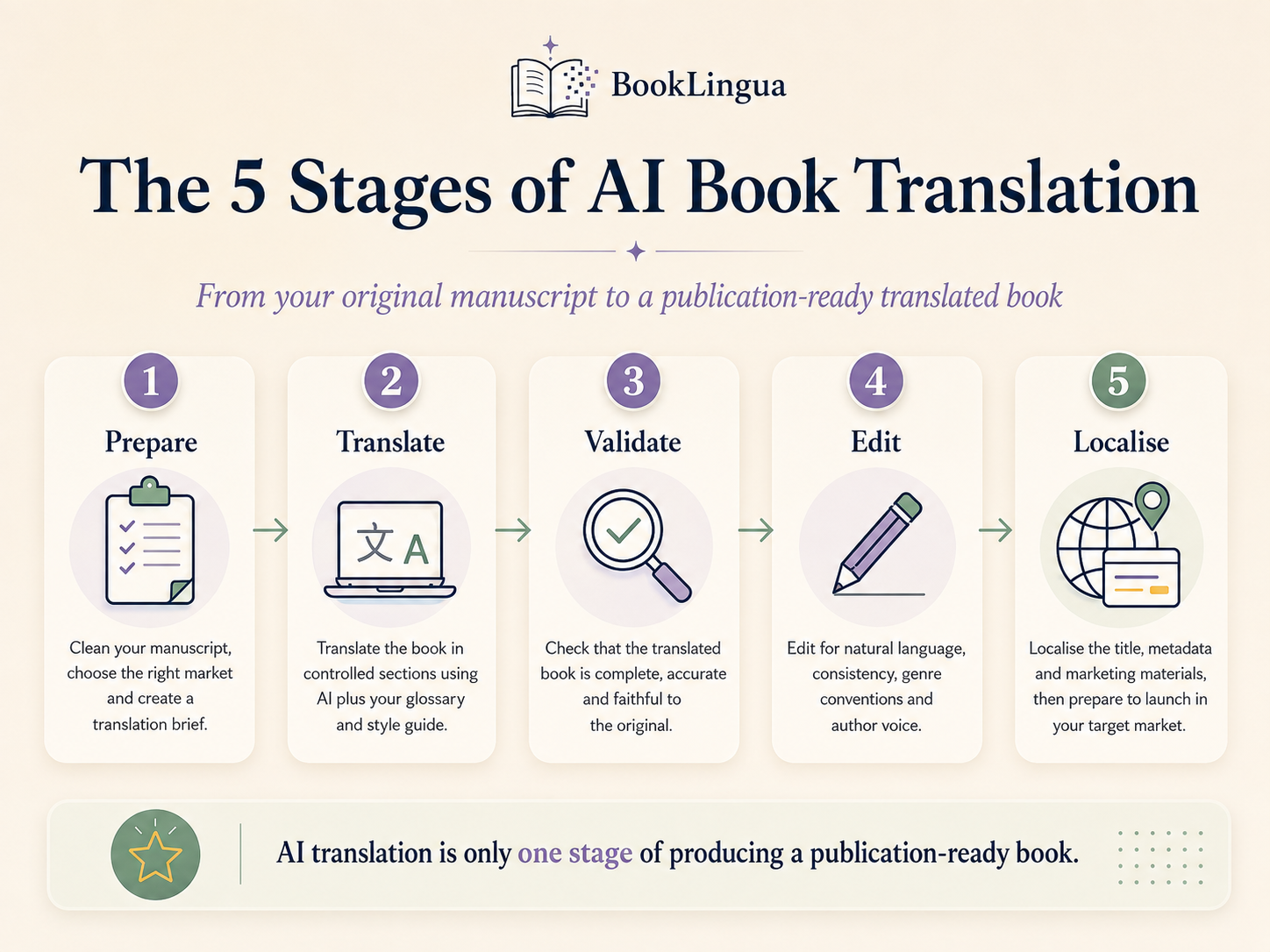
This guide explains how to translate a book with AI, broken down into five key stages:
- Preparation
- Translation
- Validation
- Editing
- Localisation
I'll take you through the whole process, from cleaning your source manuscript and creating a translation brief to reviewing, formatting and launching the finished book.
Short on time? Check out the short video below where BookLingua founder Teddy Smith explains the five stages involved in turning an original manuscript into a publication-ready translated edition.
How do you translate a book with AI?
To translate a book with AI, you need to:
- Prepare and clean the original manuscript.
- Choose a target language and specific publishing market.
- Create a detailed translation brief and terminology glossary.
- Translate the manuscript in controlled, trackable sections.
- Validate that the translated book is complete and faithful to the original.
- Edit the text for natural language, genre conventions and author voice.
- Arrange native-language review.
- Format and proof the final files.
- Localise the book's title, description, keywords and marketing materials.
- Plan how the translated edition will reach readers.
The AI translation itself is only one stage. The work you do before and after it is what turns that raw translation into a book you can confidently publish.
Can AI translate an entire book?
Yes, AI can translate a full-length book.
Current AI systems can work with context and follow instructions about tone, genre, terminology and character voice. That makes them far more useful for long-form fiction and nonfiction than older tools that translated one sentence at a time.
But a full manuscript brings its own challenges. Over the course of a book, an AI system may:
- Translate the same term differently in different chapters
- Flatten or change a character's voice
- Miss or duplicate a section
- Leave headings or titles untranslated
- Handle idioms too literally
- Change pronouns or relationships
- Confuse speakers
- Alter formatting
- Add information that was not in the original
- Include internal instructions in the output
- Produce text that is accurate but unnatural
That's why you need a controlled process: one that keeps the translation aligned with the source and checks the finished manuscript as a complete book, not just a collection of good-looking passages.
Stage 1: Prepare
Step 1: Decide whether the book is ready for translation
Start with a manuscript that is fully edited and unlikely to change. Any revisions you make afterwards will also need to be found and applied in every translated edition and that quickly creates a lot more work.
Before you start, ask yourself:
- Has the manuscript been professionally edited?
- Are the chapter order and headings final?
- Is the front and back matter complete?
- Are character names and invented terms consistent?
- Do I control the translation rights?
- Is the book's positioning clear?
- Does the existing cover communicate the correct genre?
- Is this a standalone book or part of a series?
- Will readers be able to continue the series in their language?
- How will I market the translated edition?
You don't have to have a bestseller on your hands before translation makes sense. Some authors translate a proven title, while others use translation to test whether a book can find a stronger audience elsewhere.
What matters is being clear about why you are translating the book and how the new edition fits into your wider publishing strategy.
Translation can open up a new market but it won't automatically solve unclear positioning, an unsuitable cover or a lack of reader demand.
Step 2: Choose a language and a specific market
Don't choose a language simply because lots of people speak it. The best first market for your book will depend on factors such as:
- Genre and subgenre
- Local reader demand
- Ebook and print buying habits
- Competition
- Comparable authors
- Advertising costs
- Available retailers
- Your existing international readership
- Your ability to reach readers in that market
- Whether you can translate the rest of the series
You also need to distinguish between a language and a market.
For example, Spanish gives authors access to readers in Spain, the United States and multiple Latin American countries. However, the same description, vocabulary, pricing and advertising strategy will not necessarily work equally well across all those markets.
Portuguese intended for Brazil will also require different language and market decisions from Portuguese intended for Portugal.
Choose your primary reader and marketplace first. Then make every translation and localisation decision with that audience in mind.
Step 3: Clean and structure the source manuscript
A cleaner source file gives you a cleaner, more reliable translation. Before translating, remove anything that should not appear in the published edition, such as:
- Comments
- Tracked changes
- Editorial notes
- Placeholder text
- Old chapter versions
- Hidden or duplicated passages
- Instructions for designers or formatters
Then check that:
- Every chapter has a clear heading
- Chapters appear in the correct order
- Scene breaks are marked consistently
- The title and subtitle are final
- Front and back matter are clearly identified
- Links are working
- Footnotes and references are complete
- Lists and tables have a clear structure
- Special formatting is used consistently
Next, flag anything that may need special handling, such as:
- Character and place names
- Invented terminology
- Magical systems
- Company or product names
- Quotations
- Song, film or book titles
- Legal, medical or technical terminology
- Bibliography entries
- Text messages, letters and diary entries
- Words that should remain in the source language
If your source manuscript is messy, that mess can carry straight into the translation, even when the individual sentences look good at first glance.
Step 4: Create a translation brief
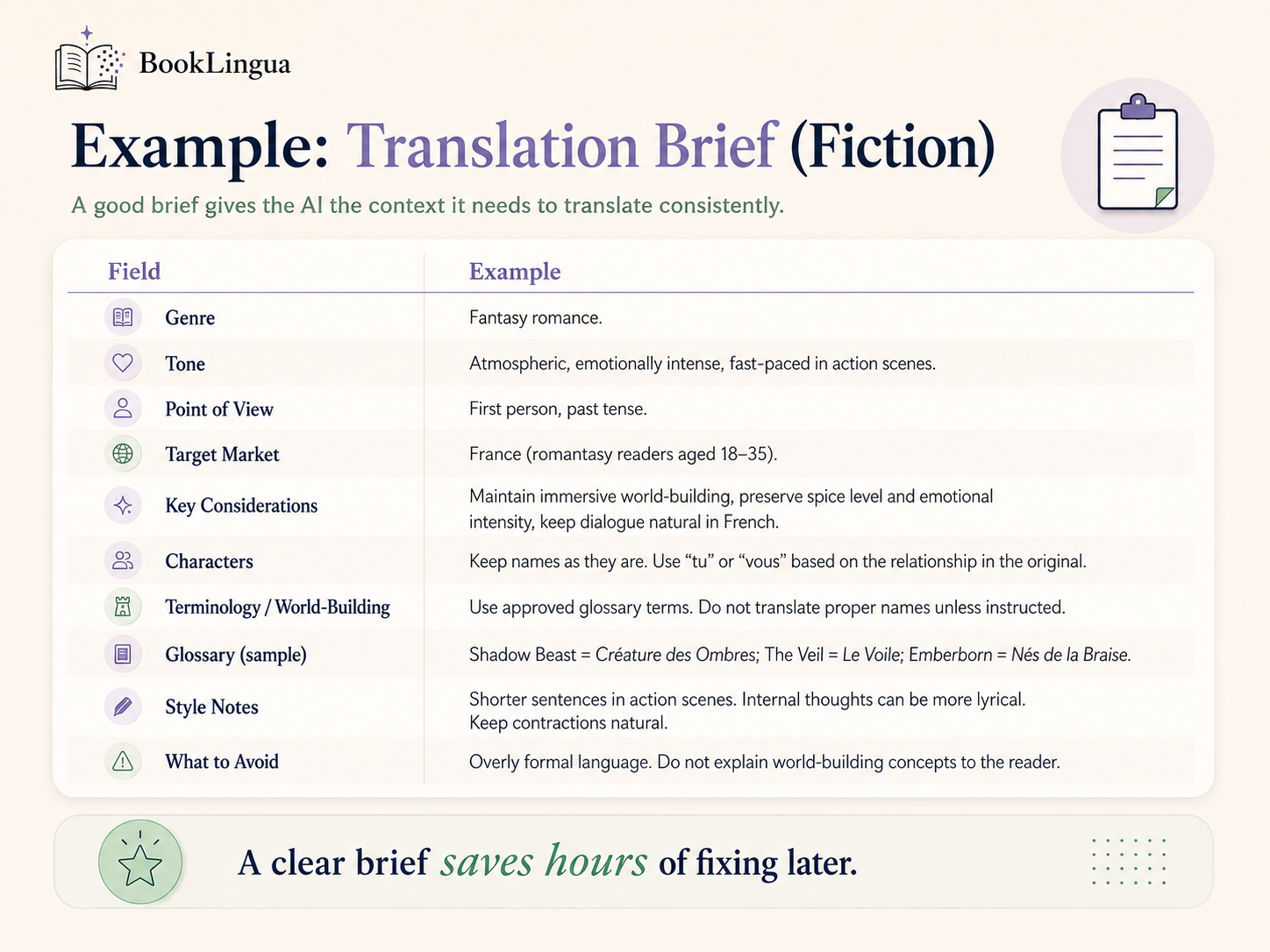
A translation brief tells the AI, and anyone managing the project, what kind of book this is and how the translated edition should feel.
Simply saying "Translate this manuscript into German" is nowhere near enough!
A useful brief gives the translation real context. Use the prompts to think about how to describe your book, its style, its terminology and the readers you want to reach:
-
Book information
Record:
- Title and series
- Genre and subgenre
- Intended readership
- Age category
- Point of view
- Tense
- Setting
- Overall tone
- Relevant content warnings
-
Style and voice
Explain:
- Whether the prose is formal or conversational
- Whether the tone is dark, humorous, emotional or fast-paced
- The author's usual sentence style
- The level and type of slang
- The level of explicit content
- How major character voices differ
- Whether the narrator is reliable, ironic or deliberately unusual
-
Terminology
Create a glossary containing:
- Character names
- Place names
- Invented terms
- Magical objects or systems
- Repeated phrases
- Titles and forms of address
- Technical vocabulary
- Words that should not be translated
- Approved translations for important terms
-
Market information
Specify:
- Target language
- Target country or region
- Appropriate spelling conventions
- Formal or informal forms of address
- Regional vocabulary preferences
- Cultural references that may need adaptation
Think of the brief as the project's anchor. It becomes even more valuable when you translate a series, because you can carry the same terminology, character voices and style decisions into every later book.
Stage 2: Translate
Step 5: Translate the book in controlled sections
Break a long manuscript into manageable, trackable sections but make sure each section still has enough context for the story and language to remain consistent.
A controlled translation process should:
- Preserve the chapter structure
- Keep headings clearly labelled
- Apply the same glossary throughout
- Retain names consistently
- Provide relevant narrative context
- Keep source and translated sections aligned
- Record which sections have been completed
- Separate instructions from manuscript text
- Prevent prompts or processing notes from entering the book
This matters especially in fiction, where the translation needs to keep track of characters, relationships and emotional context. It should always be clear:
- Who is speaking
- What has happened earlier
- The relationship between the characters
- The emotional tone of the scene
- Whether the passage is romantic, humorous, tense or threatening
- How recurring words and phrases were translated previously
- Whether the dialogue is sincere, sarcastic or deliberately misleading
Treat your book as one connected narrative, not thousands of unrelated sentences.
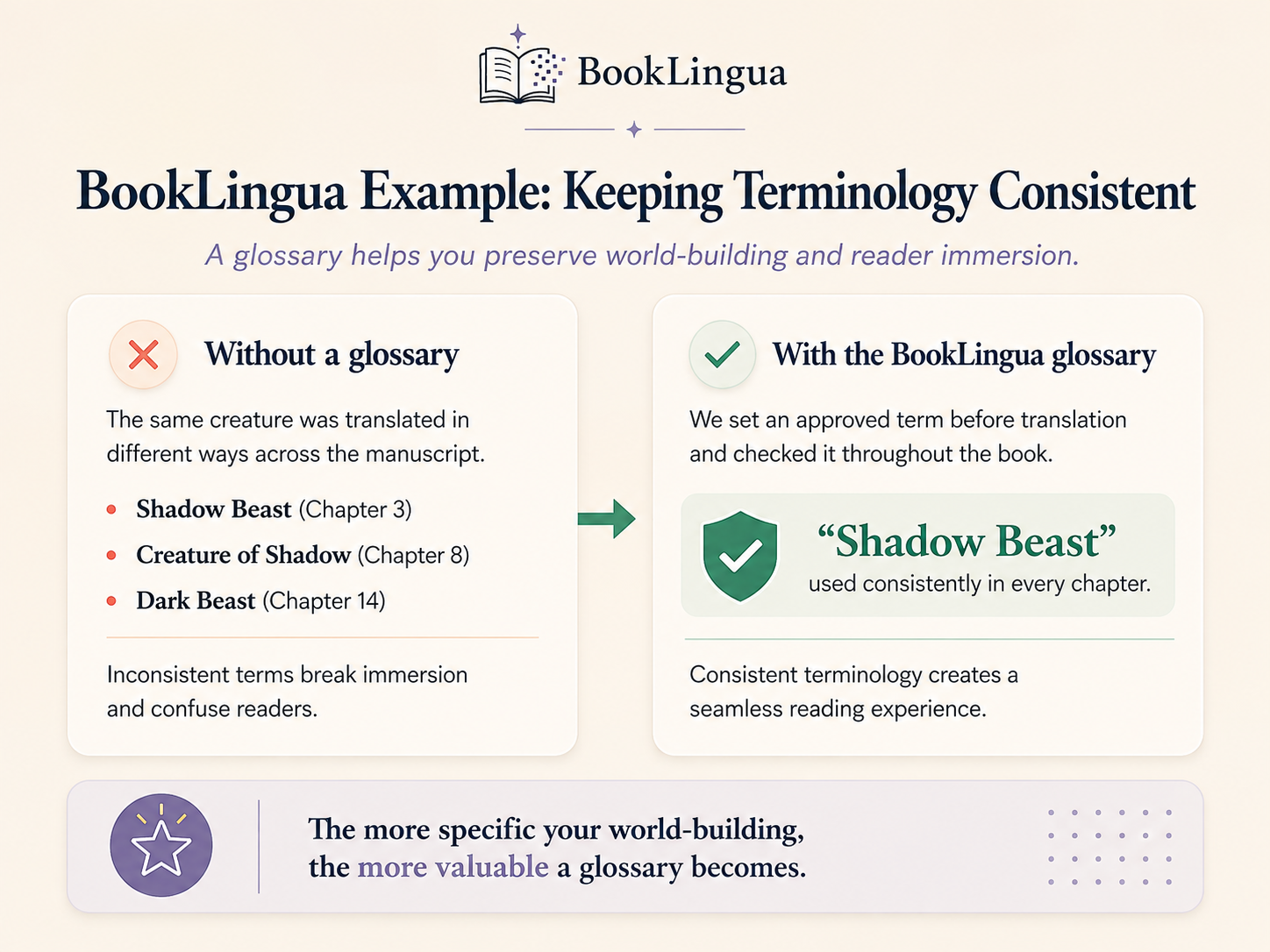
BookLingua example: keeping a fantasy glossary consistent
A recent translation of a fantasy novel included repeated world-building terms across multiple chapters and in different contexts. Translating each section independently could have produced several versions of the same magical objects, places and mythical creatures, all of which would have been very confusing for the reader!
We ran a pre-translation scan to identify the words and phrases that needed consistent treatment, then checked the completed manuscript for variations before it reached editorial review.
Keep a translation record
For a long manuscript, keep a simple record of:
- The source section
- The translated section
- The relevant chapter
- The translation version
- Any terminology decisions
- Any passages requiring later review
- Whether validation has been completed
That record makes it much easier to trace errors, replace revised sections and confirm that you have processed the entire manuscript.
Stage 3: Validate
Step 6: Confirm that the whole book is present
Before you start judging the quality of the prose, make sure the whole book is actually there and in the right shape. Check that:
- The chapter count matches the original
- Every chapter appears once
- No passages are missing
- No sections have been duplicated
- The chapters remain in the correct order
- Scene breaks remain in place
- Headings have been translated where appropriate
- The title and subtitle have been handled correctly
- Front and back matter appear in the correct order
- Links, references and footnotes remain intact
- Tables and lists still contain the correct information
- No internal prompts, comments or notes appear in the output
It is easy to underestimate this stage. An individual chapter may read beautifully while the manuscript as a whole is still incomplete. The system might translate every main chapter but miss the title page, duplicate the acknowledgements or alter part of the bibliography.
You need to validate the manuscript as a complete book, not just approve each chapter in isolation.
BookLingua example: a translation that read well but was incomplete
Translated chapters can often appear correct when reviewed individually. It's only when you do a structural comparison with the source manuscript that you notice that the material outside the main chapters has not been handled correctly.
That's why BookLingua pre-checks chapter counts, section order, front and back matter, headings and duplicated or missing text before moving to language editing. And it runs this check right at the beginning, before you place your order.
Step 7: Compare the meaning with the original
Once you know the structure is complete, compare the translation with the source.
Look for:
- Changes in meaning
- Missing details
- Added information
- Incorrect pronouns
- Altered relationships
- Changes in tense
- Changes in chronology
- Inconsistent terminology
- Variations in names
- Factual errors
- Dialogue assigned to the wrong speaker
- Changes in the intensity or certainty of a statement
Small changes can make a big difference. For example, "might", "will" and "must" do not communicate the same level of certainty. A familial relationship should not become romantic. A character who suspects something should not suddenly know it as a fact.
For nonfiction, you might also need to check:
- Dates
- Measurements
- Statistics
- Citations
- Technical language
- Quotations
- Warnings and instructions
Step 8: Check consistency across the manuscript
You need to check consistency across the whole book, not just within each chapter.
Review the whole manuscript to check that:
- Character names remain identical
- Places and invented terms use the approved translations
- Titles and forms of address stay consistent
- Formal and informal speech follow the intended relationships
- Character voices remain recognisable
- Recurring phrases are treated consistently
- The same object or concept does not acquire several different names
- Series terminology matches earlier translated books
A glossary will reduce inconsistencies, but it cannot replace a full-manuscript review.
Stage 4: Edit
Step 9: Edit for natural language and author voice
Accuracy matters, but it is not enough on its own. A sentence can preserve the basic meaning and still sound stiff, unnatural or unintentionally funny in the target language.
Think about English expressions such as:
- His eyes burned with desire.
- She melted into his embrace.
- He took her breath away.
- Their eyes locked.
An English-speaking reader understands these phrases figuratively. Translate them too literally and they can suddenly sound physical, or even ridiculous. Every genre brings its own version of this problem:
Romance
Flirting, intimacy, emotional tension and dialogue need to feel natural. A translation can retain the literal meaning while losing all the chemistry.
You need to pay particular attention to:
- Terms of affection
- Levels of formality
- Sexual language
- Emotional intensity
- Power dynamics
- Banter
- Repeated romantic imagery
Thriller and suspense
Pace and sentence rhythm are essential in thrillers. Overly formal or explanatory language can make an urgent scene feel slow.
Fantasy
Invented language, mythology and world-building need to feel evocative and internally consistent. Names and magical terminology should not sound accidental or change from chapter to chapter.
Humour
Jokes, wordplay and cultural references may need to be adapted rather than translated directly. The objective is to create a similar response from the new reader, not necessarily to preserve every original word.
Nonfiction
Technical terminology needs to be correct, but the book must still read naturally. An accurate translation can still feel inaccessible if it follows the source syntax too closely.
The editorial review should consider:
- Dialogue
- Rhythm
- Sentence structure
- Emotional intensity
- Humour
- Idioms
- Metaphors
- Romantic and sexual language
- Genre conventions
- Character differentiation
- Regional language
- Cultural references
The goal is not to rewrite your book. It is to give a reader in another language the experience you intended them to have.
Step 10: Add native-language review
A native-language reviewer can spot problems that you may never see if you only read the source language.
For example, a native speaker will easily spot:
- Unnatural phrasing
- Incorrect regional vocabulary
- Inappropriate or outdated slang
- Unintended humour
- Dialogue that is too formal
- Language that does not match the genre
- Cultural connotations
- Phrases that are accurate but not idiomatic
- Marketing copy that feels translated rather than written for the market
A full native-language edit can be expensive, and not every project needs the same level of review. If your budget is limited, you could ask a native speaker to:
- Review sample chapters
- Review dialogue-heavy or stylistically difficult scenes
- Check intimate, humorous or sensitive passages
- Complete a full language edit
- Proofread the final manuscript
- Review the title and marketing copy
- Review Book One before translating the rest of a series
Whatever route you choose, make sure you understand exactly what level of human review is included.
"AI translation", "AI-assisted translation with native-language review" and "fully human translation" are different production models, all involving different levels of review. Make sure you know exactly what you're getting.
Stage 5: Localise
Step 11: Format and proof the finished book
Once the translated text has been approved, it needs to be formatted. That means checking:
- Chapter styles
- Paragraph indents and spacing
- Scene breaks
- Contents pages
- Front matter
- Copyright information
- Back matter
- Author biography
- Links
- Footnotes
- Tables
- Ebook navigation
- Print layout
Always preview the ebook on several screen sizes, and review the print edition separately.
The final proof should also confirm that:
- The correct language is used throughout
- No source-language placeholders remain
- The translated title is consistent
- Links point to the correct marketplace
- Calls to action make sense for local readers
- References to other books reflect their availability in that language
- Any reader magnets or mailing-list pages are available to the intended audience
- Copyright, publisher and contributor information is correct
A file can be technically valid while still containing visible mistakes. Don't be tempted to skip formatting and proofing simply because the text has already been reviewed.
Step 12: Localise the title and book metadata
The manuscript is only one part of the new edition. You also need to localise the:
- Title
- Subtitle
- Series information
- Book description
- Author biography
- Backend keywords
- Categories
- Advertising copy
- A+ Content
- Website copy
- Reader-magnet pages
- Email and launch materials
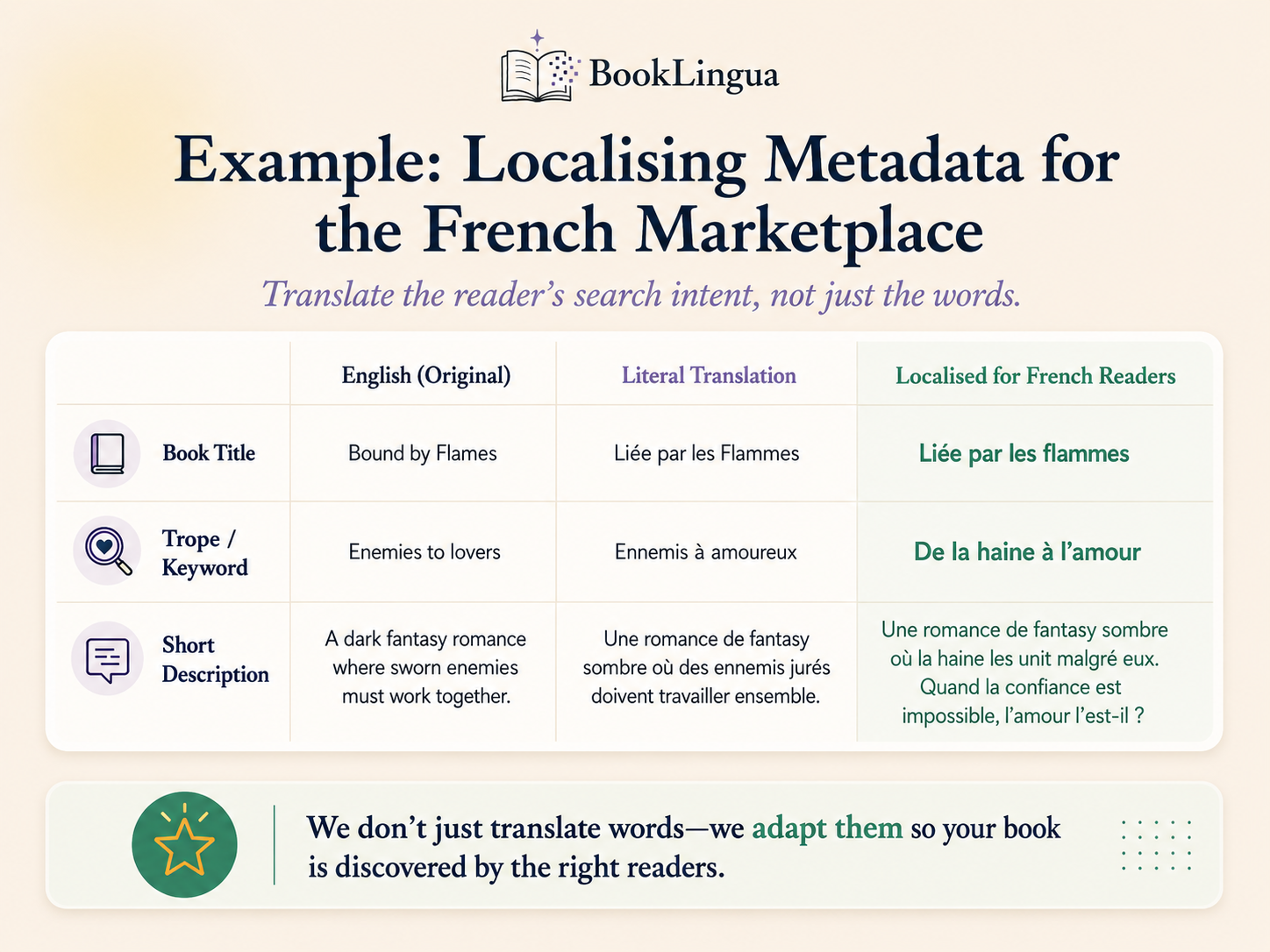
Localisation isn't about word-for-word translation. Readers in another market may use different phrases to describe the same genre, trope or subject. A keyword that works in English may not be what local readers type into Amazon or another retailer.
When we research keywords, we follow this process:
- Begin with the English keywords and advertising terms that already perform well.
- Translate the underlying search intent, rather than translating each word mechanically.
- Check search suggestions on the relevant local marketplace.
- Examine the books already appearing for those searches.
- Confirm that those results match the book's genre and intended audience.
- Test alternative wording where several local terms are used.
The goal is not simply to translate the metadata. It is to help the new edition appear in front of the right readers.
BookLingua example: translating the reader's search, not just the keyword
We recently translated a UK romance into French but quickly realised that the "enemies to lovers" trope did not necessarily match the wording readers used in the French marketplace. Rather than relying on a direct translation, BookLingua compared local search suggestions and the books appearing for relevant searches.
We chose the wording "de la haine à l'amour" ("from hate to love") because it aligned more closely with how French readers describe and search for the trope, not because it was the most literal translation of the English phrase.
Should you translate the book title directly?
Not always. A direct translation may work perfectly, but it can also sound awkward, lose an important play on words or fail to signal the right genre.
When reviewing a translated title, you need to ask:
- Does it sound natural?
- Does it communicate the genre?
- Is it memorable?
- Does it carry unintended meanings?
- Does it resemble the titles readers in this market already buy?
- Is it consistent with the rest of the series?
- Is there another book with the same or a confusingly similar title?
Step 13: Prepare the translated edition for publication
Treat each translated language version as a separate edition of the book.
Each different language edition requires its own ISBN when an ISBN is being assigned. Different formats may also require separate ISBNs. Ebook ISBN requirements can vary according to the retailer and publishing route, so authors should check the rules applying to their particular setup before publication.
You will also need to review:
- Language settings
- Contributor and translator credits
- Publishing territories
- Pricing
- Tax settings
- Categories
- Keywords
- Series links
- Cover files
- Ebook and print files
The existing cover may still work, but you need to compare it against the conventions of the target market. I always recommend having a look through similar books listed on the local Amazon marketplace to get a feel.
At minimum, the title and any other cover text will need to be updated. In some cases, the typography, imagery or genre signals may also need to change.
Step 14: Plan the launch
Translation opens the door to a new market but it doesn't automatically bring you readers. That's where the launch plan comes in.
Think about how you will help readers discover the book. Your options include:
- A free or discounted introductory promotion
- An email to existing readers
- Advance readers in the target language
- Review outreach
- Amazon advertising
- Relevant reader communities
- International book-promotion services
- Updated author and series pages
- Links from the original-language edition
- Cross-promotion from other translated titles
Authors who publish wide may also want to consider retailers and distribution channels beyond Amazon.
Depending on the language and territory, you could look at Kobo, Apple Books, Google Play Books and market-specific retailers or distribution networks. Kobo, for example, operates a self-publishing portal and distributes ebooks internationally, while Tolino is a good option for authors targeting German-language ebook readers.
You do not have to launch through every possible channel immediately. Choose the retailers and promotional methods that fit your publishing strategy and the reading habits of your intended audience.
Should you translate your own book with AI?
You can translate your own book with AI. Before you begin, ask yourself whether you:
- Are comfortable managing long manuscript files
- Understand AI prompting and context management
- Have time to compare the entire translation with the original
- Can perform structural checks
- Can maintain a terminology glossary
- Have access to a native-language reviewer
- Know how to format and publish the final files
- Are willing to research the target market
Ultimately, generating translated text is the easy part. You still need to turn it into a complete, consistent and publication-ready edition. You can manage that process yourself, but a managed service removes much of the technical and editorial burden.
With a managed translation service, someone oversees:
- Manuscript preparation
- Translation briefs and glossaries
- Controlled translation
- Structural validation
- Meaning and consistency checks
- Editorial review
- Native-language review
- Formatting
- Metadata localisation
- Launch preparation
Is AI book translation good enough to publish?
A publication-ready AI-assisted translation should be:
- Structurally complete
- Faithful to the source
- Consistent
- Natural to read
- Appropriate for the genre
- Properly formatted
- Reviewed at an appropriate level
- Localised for the target market
AI has reduced one of the largest barriers to international publishing: the initial time and cost involved in translating a long manuscript.
For independent authors, that creates a real opportunity. A book that earns revenue in one language can become several editions, each reaching a new group of readers.
But translation should still be treated as a professional publishing process, not as a one-click conversion.
AI book translation checklist
Before publishing, confirm that you have:
- Finalised and cleaned the original manuscript
- Confirmed that you control the relevant rights
- Chosen a specific target language and market
- Created a translation brief
- Prepared a terminology glossary
- Translated the book in controlled sections
- Preserved the manuscript structure
- Checked for missing and duplicated passages
- Compared the translation with the original
- Reviewed terminology and character consistency
- Edited for natural language and author voice
- Added native-language review at an appropriate level
- Formatted and proofed the final files
- Localised the title, description and keywords
- Reviewed the cover for the new market
- Checked ISBN and retailer requirements
- Researched the target marketplace
- Created a launch plan
If any of these stages is missing, your book may not yet be ready for readers.
How BookLingua helps authors translate their books
We created BookLingua for authors who want to reach international readers without taking on the full cost and complexity of a traditional translation project.
We combine AI-assisted translation with a structured, genre-aware workflow that takes your book from the original manuscript to a complete translated edition.
When you translate your book with BookLingua, you get:
- Full-manuscript translation delivered as an EPUB or DOCX file
- Pre-translation briefs and terminology management
- Structural quality checks
- Meaning and consistency review
- Editorial and native-language review by a human
- Genre-aware language decisions
- Publication-ready formatting, or a file prepared for tools such as Atticus or Vellum
- Localised book descriptions
- International keyword research
- International advertising keywords
- Launch preparation
- Market-specific international marketing guidance
We don't just translate the words. We help you create a book that is ready to be read, discovered and sold in a new market.
Find out what your translation would cost
Enter your manuscript's word count into the BookLingua price calculator to see what your translation would cost.
Calculate the cost of translating your book →
For a detailed comparison of traditional, DIY and managed AI translation costs, read How Much Does It Cost to Translate a Book?.
Already have a manuscript in mind?
Start your BookLingua translation →
Want to understand more about the process first?
Frequently asked questions
How long does it take to translate a book with AI?
AI can generate the first translation far faster than a traditional human-only process.
However, the total project time depends on the book's length, complexity, genre, review requirements, formatting and level of native-language involvement.
At BookLingua, we aim to get a publication-ready manuscript back to you within 4 days of you placing your order.
Can I translate a book using ChatGPT?
It is technically possible to use a general-purpose AI tool to translate sections of a book.
But you will still need to manage:
- File preparation
- Prompting and context
- Chapter structure
- Terminology
- Version control
- Missing and duplicated passages
- Meaning checks
- Editorial review
- Formatting
- Metadata localisation
Do I need a human translator after using AI?
Every project needs a different level of human involvement.
However, native-language review is valuable for identifying awkward phrasing, cultural issues, regional vocabulary and genre-specific problems that may not be obvious from the source language.
The appropriate review may range from selected chapters to a full language edit and final proofread.
Can AI preserve an author's voice?
AI can follow instructions concerning tone, style and character voice, particularly when it is given a detailed translation brief and relevant context.
You still need to review the finished manuscript, because an author's style can gradually become flatter, more formal or less distinctive over the course of a long book.
Can AI translate fiction?
Yes, but fiction requires more than literal accuracy.
Character voice, dialogue, rhythm, humour, emotional tension, imagery and genre expectations all need to work in the target language. This makes editorial and native-language review particularly important.
Can I translate only the first book in a series?
Yes but think carefully about the reader's experience.
If the translated first book ends with unresolved plotlines and the remaining books are unavailable in that language, readers may be reluctant to begin the series.
Some authors use Book One to test a market. Others translate several books together so that readers can continue immediately.
Whichever approach you choose, prepare the terminology and style guide so they can be reused consistently across the series.
Do I need a new ISBN for a translated book?
Yes, if the edition requires an ISBN, each different language edition should have its own ISBN.
Different formats may also require different ISBNs. Some ebook retailers do not require authors to supply their own ISBN, so check the requirements of your publisher, distributor and retailer before release.
Should I change the cover for a translated edition?
The existing cover may work, but you need to check it against the styles of the target market.
At minimum, the title and any other cover text will need to be translated or adapted.
In some cases, local genre conventions, typography or reader expectations may justify a more substantial redesign.
Does a translated book need different keywords?
Usually, yes.
Search behaviour does not translate word for word. Local readers may use different terms for a genre, trope or subject.
Research the relevant marketplace rather than simply translating the English keywords directly.
Can I publish a translated book outside Amazon?
Yes.
Depending on your publishing strategy and target market, you may be able to distribute through Kobo, Apple Books, Google Play Books, Tolino-linked retailers and other local or international channels.
The strongest options will depend on the language, territory, format and rights you control.
For a real book-length example, see our AI book translation case study of a 38,000-word romantasy novel translated into French and German, including independent native-language reviewer findings and the corrections made before the final manuscripts were produced.
Once the files are ready, our guide to publishing a translated book on Amazon KDP covers metadata, categories, pricing, previewing and launch checks.