How Can You Check a Translation in a Language You Don’t Speak?
You don’t need to speak German, French or Spanish to understand how your translated book was checked. Here’s what to look for before you publish.

Written by Teddy Smith
BookLingua founder, author and host of The Publishing Performance Show
Translating your book is exciting, but there’s one part of the process that can feel quite uncomfortable: eventually, you have to approve a manuscript written in a language you may not understand.
I remember translating my first book into German when my own German barely stretched beyond Guten Tag. As soon as the finished manuscript arrived, I started to panic. How would I know whether the dialogue still sounded natural? What about the joke I’d spent ages getting right? Would important terms stay consistent throughout the book? And would an emotional scene still have the same impact for a German reader?
These are completely reasonable concerns. You’ve spent months or even years shaping every part of your book, so being handed a file you can’t read and simply being told to trust it doesn’t feel like enough.
The good news is that you don’t need to speak German, French or Spanish to understand whether a sensible translation and review process has been followed. You may not be able to judge every sentence yourself, but you can still ask the right questions, inspect the evidence and arrange an extra check if you want one.
Here is how I would approach it.
1. Understand how the translation was produced
A polished file can look reassuring, but it doesn’t tell you much about what happened behind the scenes.
One translation might have gone through a detailed brief, a full translation, a separate editorial pass and several consistency checks. Another might have come straight from a single AI prompt. From the outside, both files may look perfectly tidy.
Before approving anything, I would ask the person or service translating your book to explain the process in plain English.
You’ll want to know:
- How was the translation adapted to your genre and target readers?
- Was there a separate editorial-review stage?
- How were character names and recurring terms kept consistent?
- What happened to jokes, idioms and cultural references?
- Which parts were checked by a professional translator?
- What will you receive to help you review the work?
If the answer is simply, “We translated it with AI,” I would want to know a lot more before publishing it.
2. Check that your voice was part of the brief
A translation can be grammatically correct and still feel completely wrong for your book.
A romantic hero’s teasing comment could suddenly sound cold or hostile. A warm, conversational nonfiction book might come back sounding like a technical manual. Even something as simple as a repeated term can drift: a magical object might be given one name in chapter two and a different one in chapter twelve.
That is why a clear translation brief matters so much. It gives the translator or translation system the context that can’t be guessed from individual sentences.
For fiction, I would include:
- The genre, subgenre and intended audience.
- A short description of your narrative voice.
- Notes on how formal or informal each main character sounds.
- Recurring nicknames, invented words and series terminology.
- Any humour, wordplay or emotionally important scenes that need particular care.
For nonfiction, I would focus on specialist vocabulary, the reader’s expected knowledge and any examples tied to a particular country or culture.
Our step-by-step guide to translating a book with AI explains how to put a translation brief together. It doesn’t need to be long, but it should give the process a clear picture of what makes your book sound like your book.
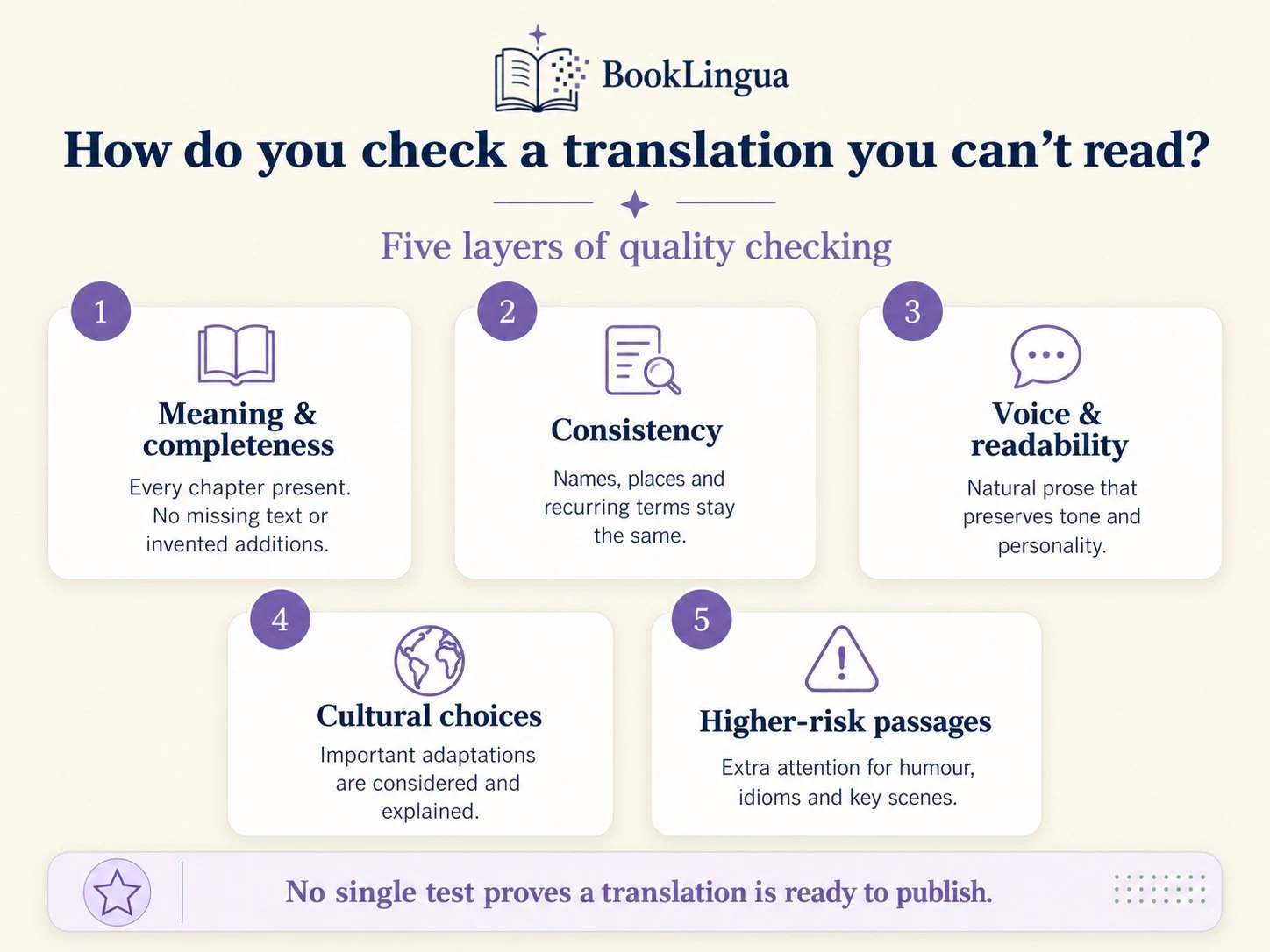
3. Look for several different types of quality check
There isn’t one magic test that proves an entire translation is ready to publish. I prefer a combination of checks because they catch different kinds of problems.
Meaning and completeness
Every chapter and section should be present, in the correct order, without missing text or invented additions. Front matter, back matter and headings need checking too.
Consistency
Names, places, specialist terms and repeated phrases should remain consistent throughout the manuscript. This becomes even more important if you’re translating a series.
For example, imagine a fantasy weapon called the Star Blade. If it becomes one German term in the opening chapters and a different term later, both translations might make sense individually, but readers may think they are two separate objects.
Voice and readability
The translated text should read naturally while keeping the meaning, tone and personality of the original. Dialogue, humour and emotional scenes often need more judgement than a straightforward factual sentence.
Cultural choices
Measurements, school systems, government terms, brands and local references don’t always transfer neatly into another market. Any meaningful adaptation should be explained rather than quietly changed.
Higher-risk passages
Some parts of a book simply need more attention than others. Jokes, idioms, intimate scenes, technical explanations and emotionally important moments are all good candidates for an additional professional check.
4. Ask to see what changed during the review
This is the point where I would ask a very simple question: Can you show me what was checked?
At BookLingua, authors receive two versions of their translated manuscript. The clean final file is the one they can prepare for publication. The Review DOCX highlights editorial improvements, so they can see where the translation was changed during review.
We also include Translation Notes to explain choices that deserve the author’s attention. That might be a joke that needed a different expression, a cultural reference that required careful handling or a phrase where several translations were possible.
You may not be able to judge the final German wording yourself, but you can still understand the decision behind it. You can see that a difficult passage was recognised, why a particular approach was taken and whether the original intention was protected.
I find that much more reassuring than receiving one clean file with no explanation of how it got there.
You can view a BookLingua example translation to see what the final manuscript, highlighted review and Translation Notes look like together.
5. Be clear about the human review you are getting
“Human reviewed” can mean very different things, so always check the scope.
A professional translator might proofread every line of the manuscript. They might review a sample. Or they might focus on selected passages where their judgement is most valuable. Those are different services and usually come with very different prices.
BookLingua combines a cultural scan, full-manuscript AI translation, a separate AI editorial pass and consistency checks. We then select passages requiring particular care for Targeted Professional Translator Review.
The professional translator focuses on areas such as dialogue, humour, idioms, culturally specific references and important scenes. This adds human judgement where it can have the greatest impact, but it isn’t a line-by-line human proofread of the complete manuscript.
If you want a professional translator to check every single sentence, that is absolutely an option; just make sure it is included in the service you commission and in the price you are comparing.
6. Arrange an independent sample review if you want extra reassurance
If you’re still nervous, I would consider asking an independent translator, editor or suitably experienced native reader to check a representative sample.
Choose sections that test different parts of the book, such as:
- The opening pages.
- A dialogue-heavy scene.
- A joke or passage containing wordplay.
- An emotionally important chapter.
- A technical or specialist section.
- Your book description and other reader-facing copy.
Give the reviewer the original English passages, your translation brief and some context about the audience. Ask whether the translated version is clear, natural and faithful to the intended meaning—not simply whether they would have chosen every word in exactly the same way.
Translation always involves judgement. Two good translators may phrase the same sentence differently, so a personal preference isn’t automatically proof of an error. What you’re looking for is a pattern of genuine problems, such as missing meaning, unnatural dialogue or inconsistent terminology.
If the sample uncovers a recurring issue, investigate it across the full manuscript. If it confirms that the voice, meaning and terminology have been handled consistently, you’ll have another useful layer of reassurance.
7. Don’t rely on back-translation alone
It can be tempting to paste the translated manuscript into another tool and translate it straight back into English. This can occasionally highlight a major shift in meaning, but it can’t tell you whether the target-language writing sounds natural.
A fluent German sentence may come back as clumsy English. Equally, an awkward German sentence might produce a perfectly acceptable English back-translation. Each extra translation introduces another round of language choices, so you’re no longer comparing the original sentence directly with the finished edition.
I would use back-translation as a clue, not as a final quality verdict.
The same applies to automated quality scores. They can help flag unusual patterns, but they can’t fully judge character chemistry, comic timing or whether an emotional scene lands with a reader.
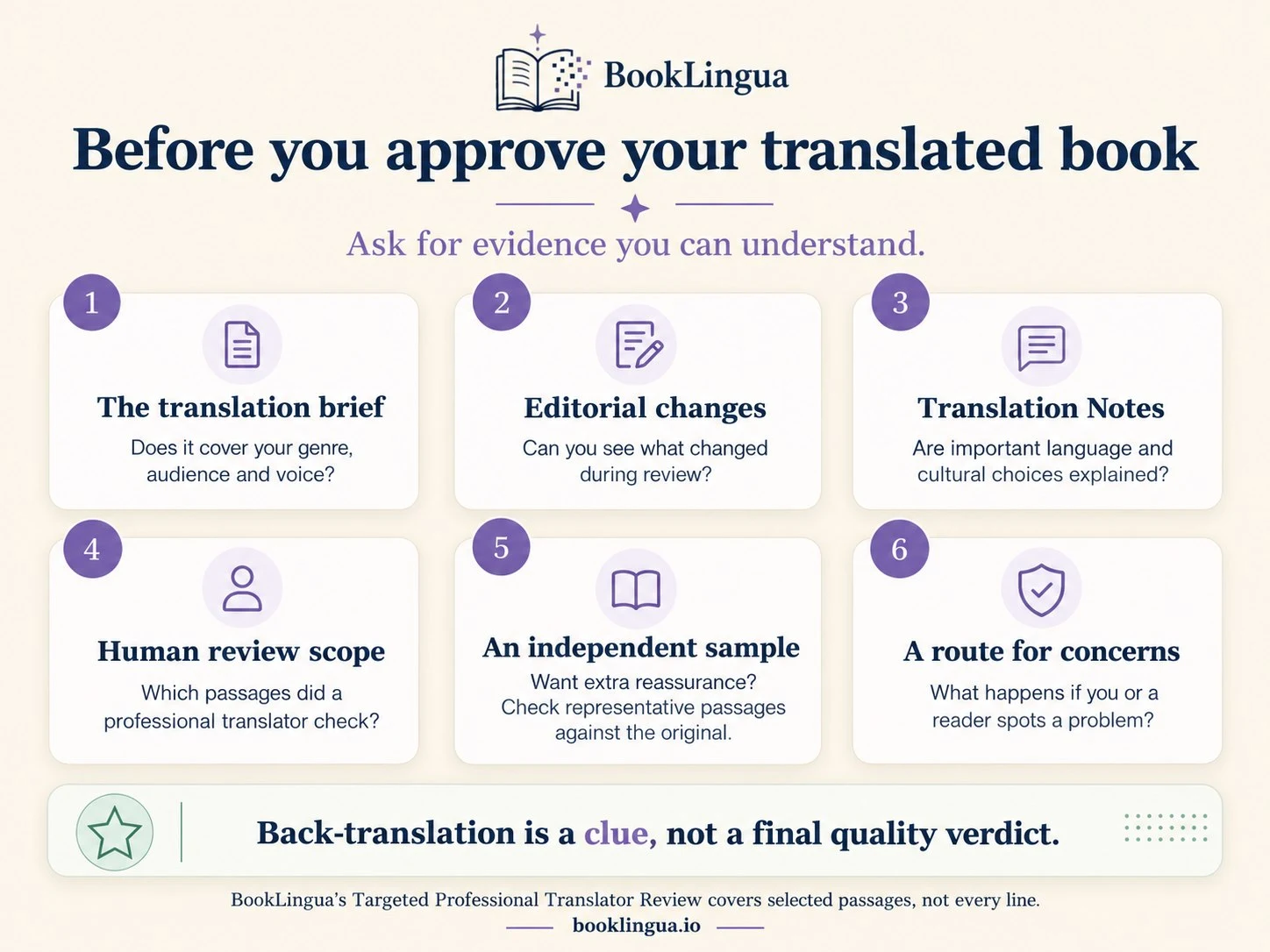
8. Ask these questions before you publish
Before approving a translated edition, I would ask:
- Was the manuscript translated with instructions specific to its genre and audience?
- Did it receive a separate editorial-review pass?
- How were names and recurring terms kept consistent?
- How were difficult passages identified?
- What exactly did the professional translator review?
- Will I receive notes explaining important editorial or cultural choices?
- Can I see the changes made during review?
- What happens if I or an independent reader raises a concern?
Clear, specific answers will tell you far more than a general promise that the translation is “high quality.”
You shouldn’t have to rely on blind trust
If you don’t speak the target language, you probably won’t ever be able to read your translated edition in quite the same way as its new readers. That’s a normal part of publishing internationally.
However, you can still understand how the translation was produced, which checks were completed and where editorial judgement was applied. You can ask to see important decisions, arrange an independent sample check and make sure you know exactly what any human review includes.
You shouldn’t need to speak German to understand how your German edition was checked.
If you’d like to see the BookLingua process in practice, you can view an example translation, including the clean manuscript, highlighted editorial changes and Translation Notes.
Frequently asked questions
Can I publish a translated book if I don’t speak the language?
Yes. Many authors publish in languages they don’t personally speak. The important thing is to use a clear translation brief, understand the review process and arrange suitable language support before publication.
Is a native-speaking beta reader enough to check a translation?
A native-speaking beta reader can provide useful feedback on clarity and reading experience, but they may not have the training to assess accuracy against the original manuscript. For a formal quality check, use a qualified translator or editor and give them both versions.
Does back-translation prove that a translation is accurate?
No. It can sometimes reveal a major change in meaning, but it won’t reliably show whether the translated prose sounds natural or preserves subtle aspects of voice.
Is every BookLingua translation checked by a professional translator?
Selected passages requiring particular care receive Targeted Professional Translator Review after the full translation and AI editorial-review stages. This provides an additional human quality check, but it isn’t a line-by-line professional proofread of the entire manuscript.
What files does BookLingua provide for review?
Authors receive a clean final manuscript and a Review DOCX showing editorial improvements. Translation Notes explain important choices and passages that may deserve the author’s attention.