Can AI Translate Romance Novels Without Losing the Chemistry?
Can AI translate romance novels without losing the chemistry? Learn how to preserve voice, tension, intimacy and character chemistry across languages.

Written by Teddy Smith
BookLingua founder, author and host of The Publishing Performance Show
Table of Contents
- Why romance is unusually difficult to translate
- Meaning is only the first layer
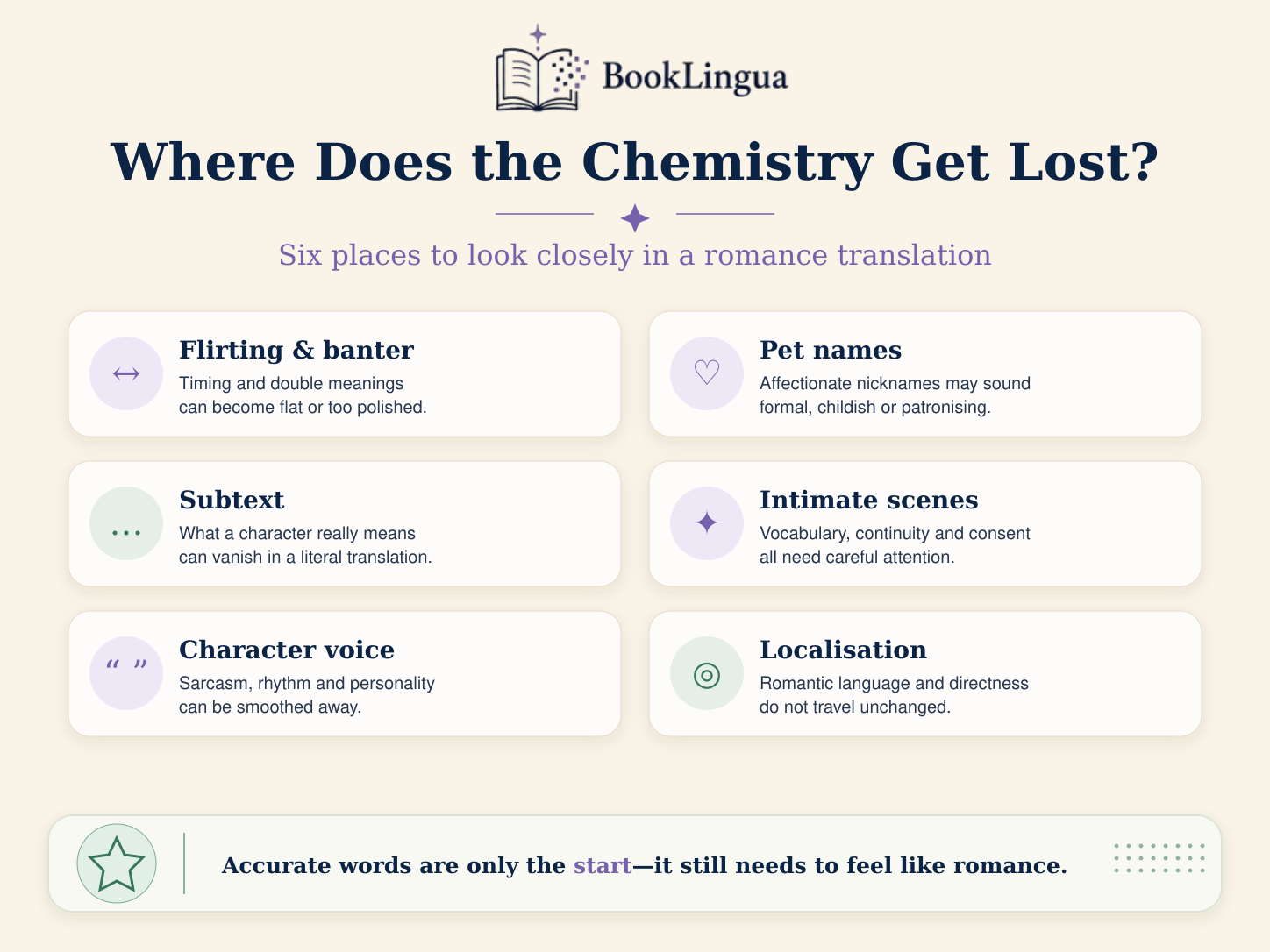
- The six places where chemistry is most likely to disappear
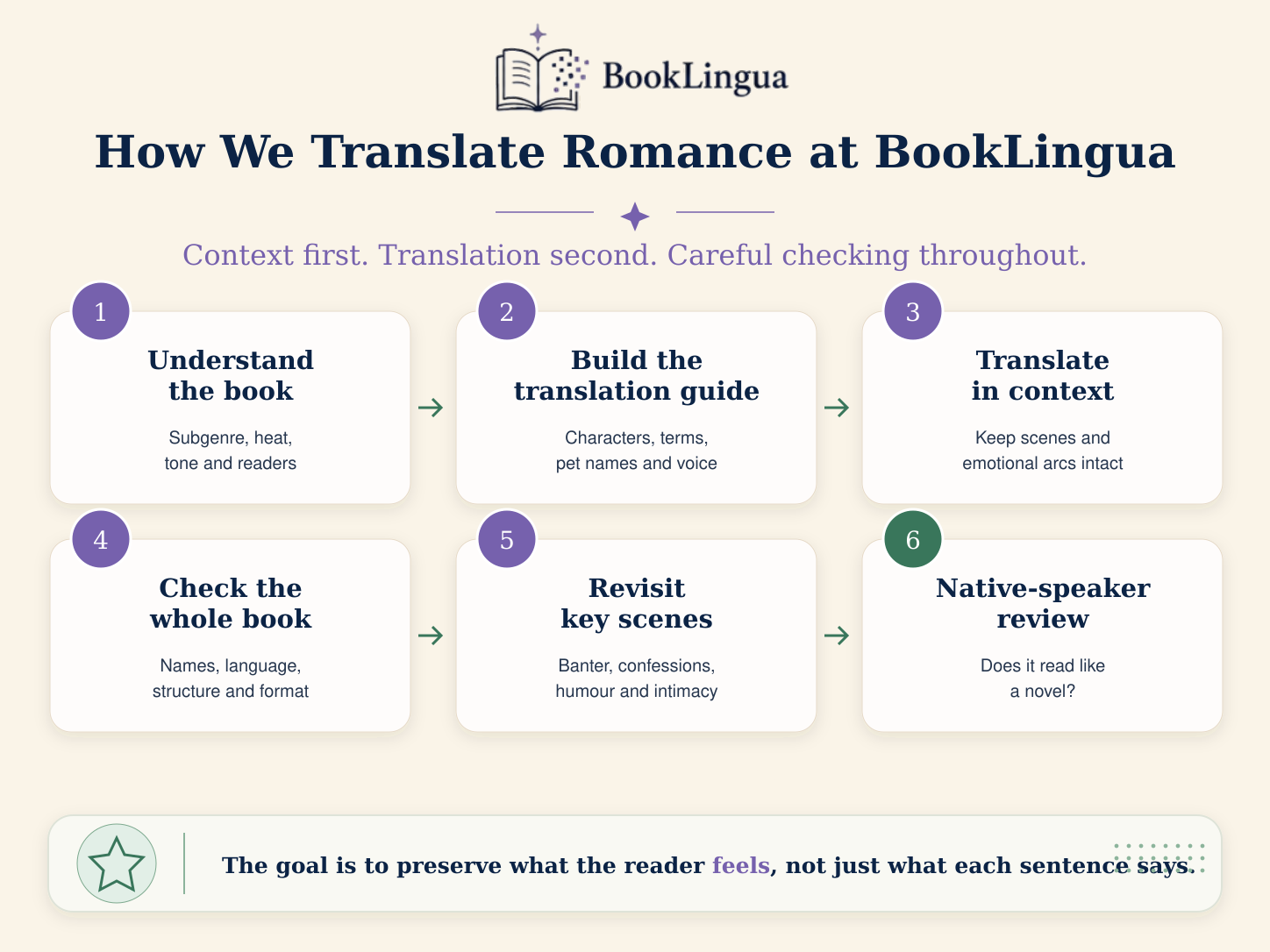
- What a romance-aware AI translation process looks like
- Does every AI-translated romance novel need a human editor?
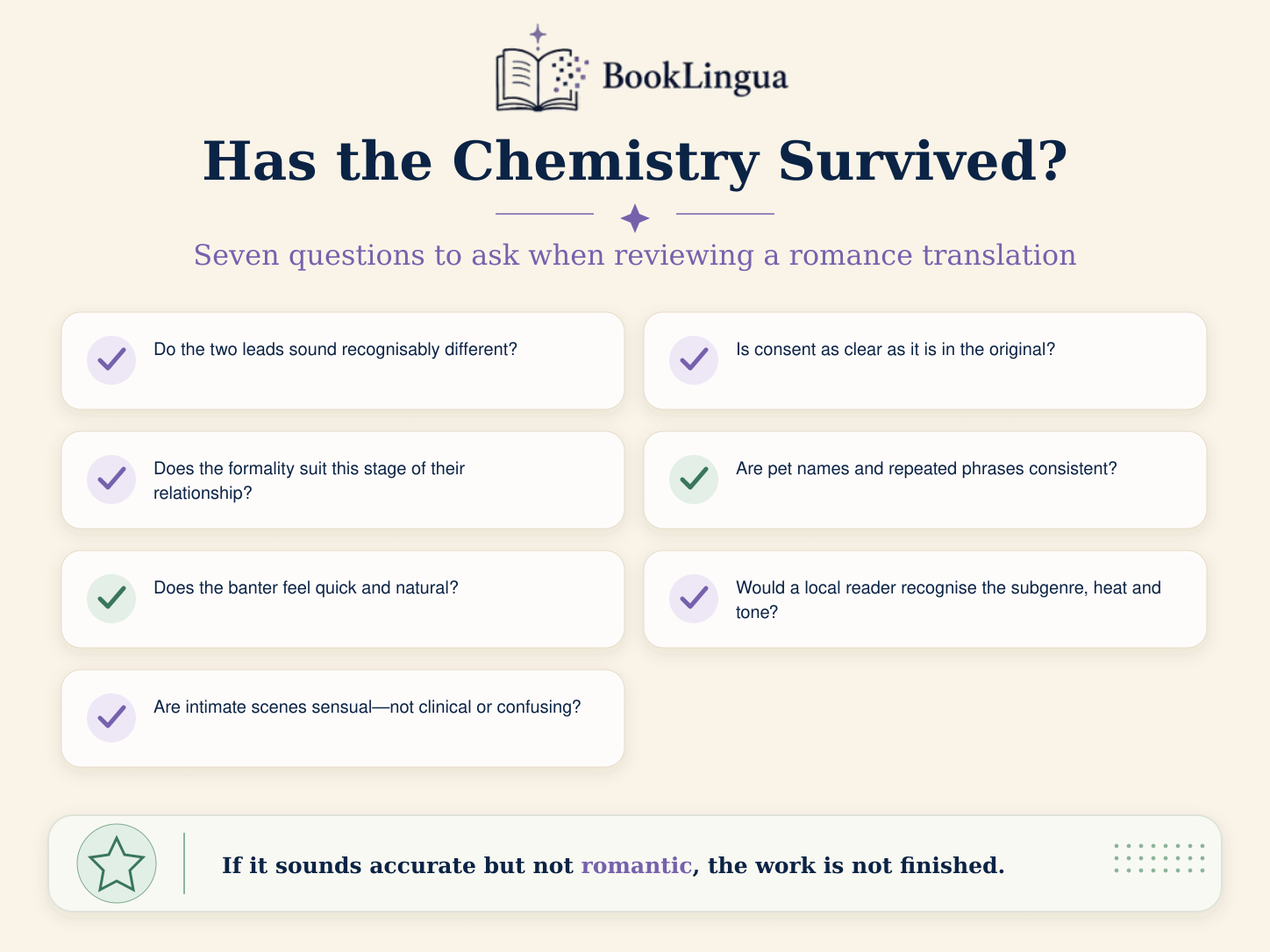
- How to test whether the chemistry survived
- So, can AI translate a romance novel well?
The short answer is yes - but there is a little more to it than asking AI to swap the English words for words in another language.
As romance readers, we are never just following the plot. We notice the hesitation before a confession, the shift in power during a flirtation, the joke that only works because two characters know each other so well, and the exact moment attraction turns into something more.
AI can translate what happens in a scene remarkably quickly. The trickier part is preserving how that scene feels.
That does not mean AI is a poor fit for romance. It simply means translation needs to be treated as an editorial process, not a one-click conversion.
If you’re new to translating, start with our step-by-step guide to translating a book with AI, which explains the full process from preparing the manuscript to final editorial review and publication.
Before translation begins, a clear translation brief helps define each character’s voice, the relationship dynamics and the terminology that must stay consistent.
Why romance is unusually difficult to translate
Every kind of fiction depends on voice and tone, but it’s even more true with romance. No one wants to read a romantic novel where a character’s declaration of love sounds like a business email, or the romantic climax reads like an instruction manual.
And this isn’t just a problem in spicy scenes. In many romance novels, the chemistry builds for hundreds of pages before the characters even touch. A good romantic translation needs to convey:
- Teasing exchanges that sound spontaneous rather than translated.
- Terms of endearment that suit the character, relationship and target culture.
- Intimate scenes that preserve consent, emotional temperature and point of view.
- Jokes, idioms or euphemisms that make sense in the target language.
A general translation tool may understand every word in these passages and still miss what you want the reader to feel. That is the gap between getting the meaning right and making the writing work as romance.
Meaning is only the first layer
AI will usually preserve the basic fact that one character is attracted to another. But romance is rarely written that directly. We use metaphor, body language, sentence length, repetition and subtext so the reader feels the attraction without having it explained to them.
Think about English phrases such as “she melted into his embrace”, “he took her breath away” or “their eyes locked”. A rigid word-for-word translation can make these images sound physical in exactly the wrong way - a character liquifying or suffocating is not sexy!
A good translation should prioritise the reading experience over the individual words. It should ask: what is this line doing here? Is it tender, playful, urgent, threatening, funny or deliberately over-the-top? How would a romance author writing naturally in the target language create the same effect?
The six places where chemistry is most likely to disappear
1. Flirting and banter
Banter works because of timing. One character pushes; the other deflects. A word is repeated with a new meaning. A deliberately polite response becomes suggestive because of what came before it.
This is where AI can accidentally flatten the exchange by choosing the safest dictionary meaning or making the characters sound too polished. Every sentence can be technically accurate while the spark quietly disappears.
You can avoid this issue by telling the system what the exchange is meant to achieve. For example, your translation brief might describe the banter as fast, dry and slightly combative, with one character hiding their true feelings behind humour.
2. Pet names and terms of endearment
“Baby”, “darling”, “love”, “sweetheart” and more character-specific nicknames carry different associations in different languages. Use the wrong translation and a pet name can suddenly sound overly sentimental, patronising or strangely formal.
Pet names can also show how a relationship is changing. A nickname used mockingly in chapter three may feel deeply intimate by chapter twenty. If the translation keeps changing it from scene to scene, the reader loses that thread.
It helps to choose important terms deliberately, add them to a glossary and review them in context. Sometimes a local equivalent is right; sometimes keeping the original name works better. The important thing is that the choice feels natural and stays consistent.
3. Emotional tension and subtext
Romance characters frequently say one thing and mean another. “You should go” may be a dismissal, a plea to stay, or a test. The surrounding scene tells the reader which one it is.
A sentence-by-sentence translation can miss that wider context. Suddenly a line feels too cold, too warm or much more explicit than you intended. The translation needs to understand the character arc, where the relationship has reached and what the viewpoint character is feeling in that moment.
4. Intimate and spicy scenes
Spicy scenes are especially easy to get wrong because the range of natural-sounding vocabulary is surprisingly narrow. A word can feel sensual in one context, clinical in another and unintentionally hilarious in a third. An anatomically precise term may be completely wrong for your voice, while a euphemism may sound coy or simply leave the reader confused.
There is also some very practical continuity to keep track of: who is speaking, where everyone is, what has already happened and whether one action follows clearly from the last. Ambiguous pronouns or an overly literal verb can turn a charged scene into a logistical puzzle.
Most importantly, the translation needs to preserve consent and agency. A softened 'might', a missing hesitation or a verb that feels more forceful can quietly change the dynamic between the characters.
5. Character voice
A rake, billionaire, small-town baker or immortal fae warrior should not all speak the same way. Neither should the two leads in a novel.
AI naturally tends to smooth things out unless you tell it what to keep. If your character speaks in clipped sentences, becomes formal when anxious or hides every vulnerable moment behind sarcasm, put that in the translation brief.
6. Cultural and regional expectations
There is no single international version of romance language. A phrase that feels completely natural in US English may need a different level of directness in German, French, Italian, Spanish or Brazilian Portuguese. Even choosing Spanish brings an early decision: are you writing mainly for readers in Spain, for a particular Latin American market, or for a broad international audience?
That choice affects vocabulary, forms of address, idioms and sometimes the whole emotional register of a scene. Translation and localisation overlap, but they are not quite the same. Translation brings your story into another language; localisation helps it feel at home there.
What a romance-aware AI translation process looks like
In our experience, the best results come from giving AI plenty of context and surrounding the translation with sensible checks. At BookLingua, we don’t just use a generic tool to process your text. We build a personalised workflow that understands your entire novel.
1. Define the book before translating it
Record the subgenre, heat level, point of view, tense, setting, readership and tone. A dark romance, a sweet small-town romance and a comic paranormal romance need very different language choices.
We are really hot on genre focus thanks to our work with romance authors and readers through our sister brand, My Romance Reads, where subgenre, tropes, heat level and emotional promise all shape which books readers choose. Those same signals should be made explicit before a translation begins.
2. Build a character and terminology guide
List names, titles, invented terms, pet names, recurring phrases and the speech patterns that distinguish each main character. Decide what must stay in English and what should be adapted.
3. Translate with scene-level context
The model needs to know what is happening emotionally, rather than receiving a pile of isolated sentences. Keeping chapters and scenes intact helps it follow pronouns, subtext and recurring language.
4. Check consistency across the whole manuscript
Search for variations in names, key terms, forms of address and repeated phrases. Confirm that chapter headings, scene breaks and italics have survived.
5. Review the high-risk scenes
Give extra attention to first meetings, declarations, arguments, humour, intimate scenes and any passage where the meaning depends on implication. These are the sections most likely to affect reviews.
6. Use a native-language editorial check
A fluent reviewer can quickly spot a line that is grammatically correct but simply not something a novelist would naturally write. Depending on your budget and the book, they might review the whole manuscript or concentrate first on the passages and scenes where the stakes are highest.
Does every AI-translated romance novel need a human editor?
I would always recommend some level of human review when it comes to romance novel translations.
How much human review you need depends on your book, your target market and how cautious you want to be. A flagship series entering a major new market deserves more scrutiny than a small test with a short backlist title. A highly stylised, funny or very spicy novel will usually need a closer look than straightforward prose.
A practical approach is to work in layers:
- Structural validation: confirm that nothing is missing, duplicated, reordered or left untranslated.
- Automated consistency review: check names, terminology, punctuation, dialogue and formatting.
- Targeted native review: examine the opening, key emotional beats, intimate scenes and a sample from across the book.
- Full native-language edit: the strongest option when the title, budget and commercial opportunity justify it.
Read Why Editorial Review Matters in AI Book Translation for a closer look at what the additional review stage catches.
How to test whether the chemistry survived
Don’t settle for a vague feeling that the translation 'looks fine'. Give your reviewer a few specific questions, such as:
- Do the two leads sound recognisably different from one another?
- Does the level of formality suit their relationship at this point in the story?
- Does the banter feel quick and natural?
- Are the intimate scenes sensual in the intended way, rather than clinical, euphemistic or comic?
- Is consent as clear in the translation as it is in the original?
- Do pet names and repeated phrases develop consistently through the book?
- Would a romance reader in this market recognise the subgenre and tone?
You can also ask your reviewer to explain a few important passages back to you in plain English. You don’t need a literal back-translation; you need to know that the emotional intention, power dynamic and character voice are still there.
So, can AI translate a romance novel well?
Yes. AI can now do enough of the heavy lifting to make romance translation faster and financially possible for many independent authors. But that doesn’t mean the book is ready to publish!
It’s not about whether the AI translates every sentence, but whether a reader in the new language experiences the characters and their story arc in the right way.
To get there, you need genre-aware instructions, enough context, consistency checks, careful attention to the moments that matter and, ideally, input from someone who reads naturally in the target language.
Put those pieces in place and AI does not have to drain the chemistry from your romance novel. It can help you carry that chemistry to a whole new group of readers.
Our romantasy AI book translation case study shows this process on a complete 38,000-word novel, including French and German native-language reviews and the refinements made before delivery.
When the translated files are complete, use our Amazon KDP publishing guide to prepare the listing, metadata, price and final preview.
Ready to see what your romance novel could look like in another language? BookLingua helps you translate genre fiction in hours, not months, while keeping preparation, consistency and editorial review at the heart of the process. Get an instant price and start your translation.