Can AI Translate a Novel? We Put BookLingua to the Test
Can AI translate a complete novel? We put BookLingua to the test by translating a 38,000-word romantasy book into French and German.

Written by Teddy Smith
BookLingua founder, author and host of The Publishing Performance Show
The short answer is yes, but we wouldn’t recommend asking a general AI tool to translate your manuscript and then uploading the result straight to Amazon.
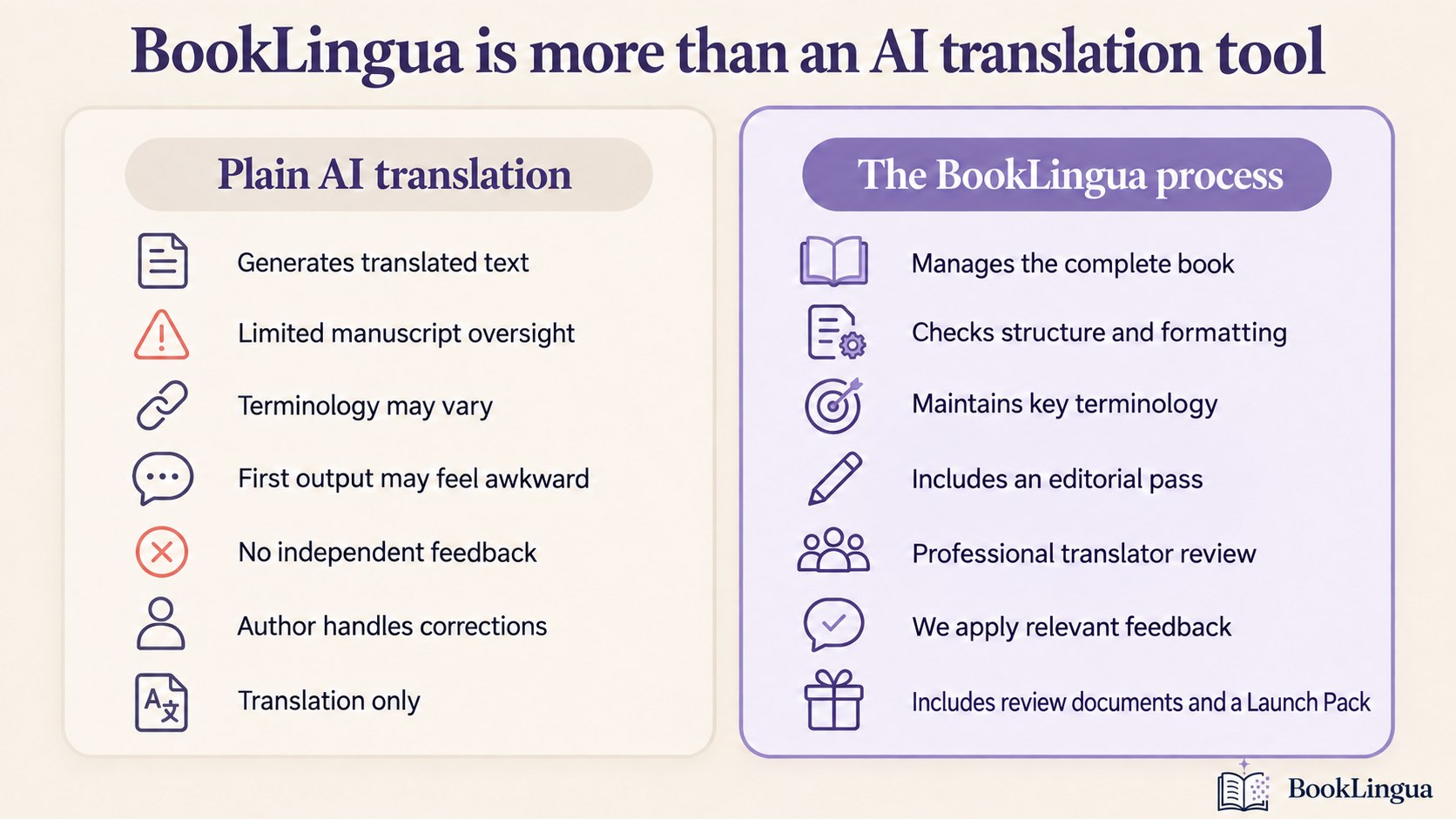
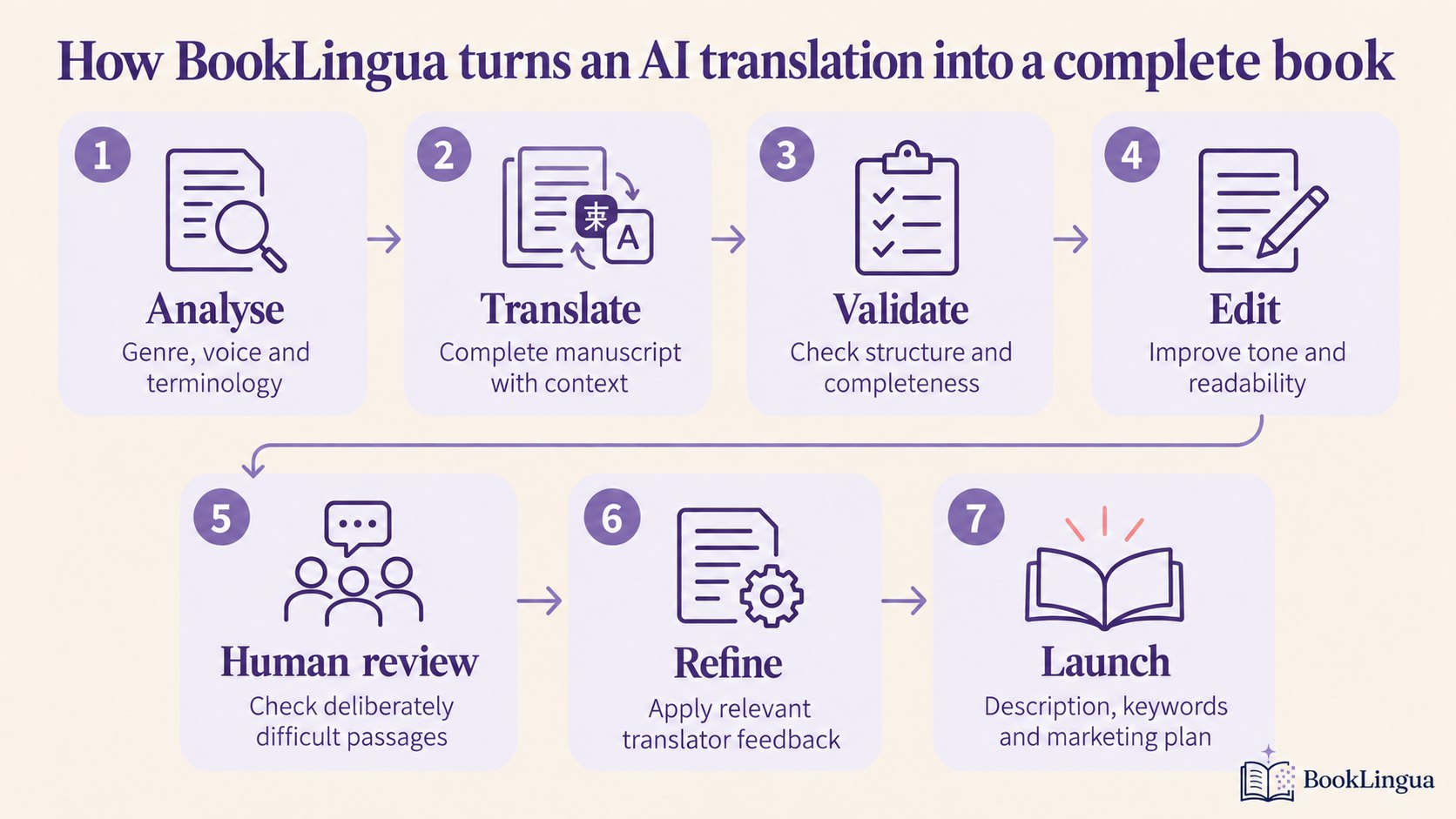
BookLingua uses AI as part of a managed book translation process. We analyse the manuscript, identify important terminology, translate the complete book, check that nothing is missing or duplicated and then put the translation through a separate editorial pass.
We also select particularly difficult passages for review by a professional translator. Their feedback comes back to us, we use it to improve the manuscript and the author receives the complete report alongside the translated book.
That combination matters. AI makes translating a complete novel much faster and more affordable. The wider BookLingua process helps us catch the structural, linguistic and stylistic problems that can appear in a raw AI translation.
But does that process actually work on a real novel?
To find out, we used BookLingua to translate Bride of the Hollow King, a 38,000-word gothic romantasy novel, from English into French and German. We then asked native-language readers to assess the opening chapters and tell us honestly whether they would keep reading.
The results were better than we expected, but they also showed why the managed process around the AI is so important.
See the evidence
Read the complete French and German AI book translation case study, including the covers, opening excerpts and reviewer scores.
Table of Contents
- Why a plain AI translation isn’t enough
- What BookLingua adds to the AI
- Why we chose Bride of the Hollow King
- What the complete BookLingua process produced
- What the reviewers still found
- What we did with the feedback
- Could you translate a novel with ChatGPT yourself?
- Does an AI-translated novel still need human review?
- It is about more than the manuscript
- What this test taught us
- Is BookLingua right for your novel?
- Find out what it would cost to translate your book
- Frequently asked questions
Why a plain AI translation isn’t enough
It is surprisingly easy to make AI translation look good in a short demonstration.
Choose an interesting paragraph, ask an AI tool to translate it and the result will often seem very convincing. If you speak the target language, you might spot a phrase you would change, but the overall quality can be impressive.
However, a full novel is a much harder test. A novel has recurring characters, relationships, invented terms, jokes, metaphors and scenes where the real meaning sits somewhere beneath what is actually being said.
A translation can be technically accurate and still lose the voice, atmosphere or emotion that made the book worth reading in the first place.
The translation also has to remember decisions made hundreds of pages earlier. A place, magical object or character nickname cannot quietly acquire three different names. The heroine should still sound like the same person in chapter twenty. If two characters become less formal with each other as their relationship develops, the language needs to reflect that.
Then there is the manuscript itself. Every chapter needs to be present, in the right order and only once. Headings, scene breaks and formatting need to survive. A translation that contains beautiful prose but misses half of Chapter Eleven is not a successful translation!
A general AI tool can produce translated text. Turning that text into a complete, consistent and readable book requires a process around it.
What BookLingua adds to the AI
We created BookLingua to manage the parts of book translation that do not fit into a single prompt.
Before the translation begins, we analyse the manuscript and ask the author for information about the genre, tone, characters and intended market. We identify recurring names, places and terminology, as well as cultural references and passages that may require special attention.
That preparation starts with a clean source file and clear instructions. See our guides to preparing a manuscript for translation and creating a BookLingua translation brief.
The book is then translated in controlled sections while keeping the wider manuscript in mind. Once the initial translation is complete, we check the structure against the original to confirm that chapters and sections have not been missed, duplicated or moved.
The translation then receives a separate AI editorial pass. This looks beyond the basic meaning of each sentence and reviews tone, consistency, natural phrasing, character voice and suitability for the genre.
Our guide to editorial review in AI book translation explains why this separate pass matters.
Finally, we choose particularly challenging extracts for targeted review by a professional translator. These are not simply the easiest pages or the opening paragraphs. We look for passages where mistakes are more likely to matter: complicated imagery, dialogue, cultural references, invented terminology and emotionally important scenes.
The translator’s comments come back to BookLingua. We assess the feedback, make relevant changes to the translated manuscript and give the complete report to the author.
This is not the same as a full-manuscript human translation or proofread, and we are careful not to describe it as one. It is targeted professional input built into a much more affordable AI-led process.
Why we chose Bride of the Hollow King
We could have chosen a straightforward nonfiction book for the test. Instead, we chose romantasy because it gives any translation process plenty of opportunities to get things wrong.
Bride of the Hollow King includes gothic imagery, an invented world, romantic tension and recurring fantasy terminology. Names such as Hollow Court, Hollow King, Blackthorn Wood and Thorn Throne need to sound as though they belong to the same world while remaining consistent throughout the book.
The prose also needs to keep its atmosphere without becoming too heavy or literal. The dialogue has to preserve the differences between the characters and the romantic scenes still need to feel romantic. Nobody wants the emotional climax of a gothic love story to read like a set of assembly instructions.
We put both the French and German editions through the full BookLingua process:
- Analyse the finished English manuscript.
- Identify recurring names, places and fantasy terminology.
- Translate the complete book with its genre and wider story in mind.
- Check the translated manuscript against the original structure.
- Complete a separate editorial pass.
- Identify difficult passages and important language decisions.
- Arrange targeted human review.
- Use the feedback to improve the manuscript.
- Prepare the files and launch materials for the new market.
The final delivery was not just a translated block of text. It included a clean manuscript, a Review Document showing editorial changes, translation notes and a Launch Pack for each market.
You can see the covers, opening excerpts and reviewer scores in the full Bride of the Hollow King translation case study.
What the complete BookLingua process produced
The biggest success was that both translations still felt like the same story.
The opening of the English book reads:
“I woke beneath a canopy of thorns, with the taste of blood on my tongue and the feeling that I had been running from something I could no longer remember.”
There is quite a lot happening in that one sentence. It establishes the gothic setting, physical danger and a missing memory while moving quickly enough to pull the reader into the story.
Both translations kept those elements in the same opening beat. They did not explain the mystery away or weigh the sentence down with unnecessary detail.
That carried across the wider sample too. The French reader described the translation as smooth and felt that it established the dark fantasy atmosphere very well. They highlighted the immersive atmosphere, consistent character voices and momentum across the first three chapters.
The German reader felt that the translation read fluently and had the atmosphere expected from a dark romantic fantasy novel. They gave it 5 out of 5 for genre feel and said they would keep reading without hesitation.
That final point matters. Readers do not experience a book as a translation exercise. They experience it as a story. The real test is not whether every sentence looks impressive when placed beside the English version. It is whether the reader becomes absorbed and wants to turn the page.
What the reviewers still found
The reviews were positive, but they were not an unqualified pass.
The French reader found a small number of phrases and metaphors that followed English structures too closely. The German reader also identified some literal image descriptions and combinations of words that would benefit from smoothing.
These were not enormous errors that changed the plot. They were smaller moments where the translation felt more like a translation.
That is quite normal. A translated book may retain some flavour of the language and culture it came from. Even a skilled human translator is creating an interpretation of the original, not pretending that the author somehow wrote the same novel twice in two different languages.
Our aim is to produce a translation that is consistent, readable and faithful to the experience of the original. We cannot promise that every sentence will sound as though the book was first written in the target language. That is not always possible and, if it means stripping away the author’s style, it may not always be desirable.
However, there is a difference between preserving the character of the original and leaving in awkward language that simply needs to be improved. That is why the feedback did not just go into a report and disappear.
It came back to BookLingua so we could use it.
What we did with the feedback
This is one of the most important differences between BookLingua and a plain AI translation tool.
We do not simply send an author the first translation generated by the model. We also do not send difficult passages to a professional translator purely so we can say a human has looked at them.
The point of the human review is to identify real improvements.
When the French and German feedback came back, we reviewed the suggested changes and used them to refine the drafts. We could also look for the same patterns elsewhere in the manuscript. If one metaphor followed English too closely, for example, that gave us a reason to check whether similar imagery had been handled in the same way in other chapters.
The final report gives the author visibility over that process. They can see what the reviewer thought, what worked well and what needed further attention.
Human review therefore becomes part of the production process rather than a badge added at the end.
Could you translate a novel with ChatGPT yourself?
You can certainly experiment with it, but the difficulty is managing the process across an entire book.
If you paste a chapter into a general AI tool and give it clear instructions, you may get a very good result. For a short story or an early test, that can be genuinely useful.
Across a complete novel, however, you need to keep track of names, invented words, forms of address and character voices. You need to give the model enough surrounding context without losing control of the files. You need to confirm that every section has been translated and that nothing has been added, missed or duplicated. Then you need to edit, format and localise the result.
None of those jobs is impossible, but together they can take a lot of time.
If you want to try it yourself, our step-by-step guide to translating a book with AI explains the full process. Treat the manuscript as one connected story rather than hundreds of separate translation prompts and keep a clear glossary of every important term.
BookLingua is for authors who want the speed and affordability of AI without having to manage all of those stages themselves.
Does an AI-translated novel still need human review?
We would always recommend some level of human review before publishing an AI-translated novel.
The right level will depend on your book, budget and plans for the new market.
A major release in a market where you already have thousands of readers may justify a full professional edit of the translated manuscript. A short backlist title being used to test demand may need a more affordable approach, with strong automated editing and professional review focused on the passages most likely to reveal wider problems.
Highly stylised books also need more care. Humour, poetry, unusual narrators, heavy dialect and intricate wordplay are harder to translate than clear, straightforward prose. Romance scenes and emotionally important dialogue deserve particular attention because small changes in intensity, hesitation or word choice can alter a relationship rather than simply changing a sentence.
BookLingua includes targeted review by a professional translator, but this is not a full-manuscript human proofread. Authors who want the highest possible level of reassurance should arrange a complete edit by a professional translator or native-language editor before publication.
For many independent authors, though, the BookLingua approach offers a practical middle ground. It combines the speed and affordability of AI with a managed editorial process and professional human input. That gives authors a realistic way to test an international market without committing thousands to a traditional translation before they know whether the book will sell.
It is about more than the manuscript
A translated manuscript is not much use if nobody in the new market can find it.
That is why BookLingua also prepares a Launch Pack for each translated edition. It includes a localised book description, keyword research, category suggestions and a marketing plan for the target market.
We focus on localisation rather than translating the English sales material word for word. Readers in another country may describe the same genre or trope differently, search using different phrases and expect different things from a book cover or description.
The translation gets the book into another language. The Launch Pack helps the author take it into another market.
What this test taught us
This test did not prove that authors should hand their manuscripts to a general AI tool and hope for the best.
It showed that AI can play a valuable role when it sits inside a carefully managed book translation process.
The French and German versions of Bride of the Hollow King preserved the story, atmosphere and romantic tension well enough that both native-language readers wanted to continue. The reviewers still found phrases that were too literal or too close to English, but that feedback became part of the process. It came back to BookLingua so we could act on it and improve the translated drafts.
That is the difference between raw AI translation and BookLingua.
We do not simply generate a translation and send it to the author. We manage the book as a complete publishing project: analysing the manuscript, maintaining terminology, checking its structure, editing the translation, selecting difficult passages for professional translator review and applying the resulting feedback.
The author also receives the review documents, translation notes and practical launch materials needed to prepare the new edition for its market.
AI makes the translation faster and more affordable. The BookLingua process is what turns that initial translation into a complete book an author can review, prepare and publish.
Is BookLingua right for your novel?
BookLingua may be a good fit if you:
- Want to test a new language market without paying for a full human translation upfront.
- Have a finished and professionally edited source manuscript.
- Want a managed service rather than translating the book yourself with a general AI tool.
- Value professional human feedback on the passages most likely to cause problems.
- Understand that targeted translator review is not a full human proofread.
- Want help preparing the description, keywords and marketing plan for the new market.
It may be less suitable if the book depends heavily on poetry, experimental language, complicated wordplay or a very specific regional dialect. It may also be the wrong option if you need every line to receive individual attention from a human translator.
There is no single correct production method for every author. The important thing is to understand what you are buying, which checks are included and what you may still want to do before publication.
Find out what it would cost to translate your book
BookLingua combines full-manuscript AI translation with structural checks, a separate editorial pass, targeted review by a professional translator and launch materials for the new market.
Get an exact price
Use our book translation pricing calculator to see what it would cost to translate your manuscript.
Or, if you would like to inspect the results first, read the complete French and German AI book translation case study.
Frequently asked questions
Can AI translate a complete novel?
Yes. AI can translate a full-length novel, but generating the initial translation is only one stage. A reliable process should also include structural validation, editorial review, consistency checks and an appropriate level of human input.
How is BookLingua different from using ChatGPT?
BookLingua manages the complete translation project. We analyse the manuscript, maintain terminology, translate the book, check its structure, complete a separate editorial pass and arrange targeted review by a professional translator. We then act on the feedback and supply the author with review documents and launch materials.
Does BookLingua use human translators?
Yes. BookLingua selects difficult passages for targeted review by a professional translator. Their feedback comes back to us so we can use it to improve the draft, and the author receives the complete report. This is not the same as a full-manuscript human translation or proofread.
Is AI book translation accurate?
AI can preserve the meaning, plot and tone of a novel well, but the quality varies according to the book, language and process. Common problems include overly literal phrases, inconsistent terminology and dialogue that sounds too formal or generic. This is why BookLingua adds structural checks, editorial review and professional human feedback around the initial translation.
Can I publish an AI-translated book on Amazon?
You can publish an AI-translated edition through Amazon KDP, provided you have the necessary rights and follow Amazon’s current content and disclosure requirements. You should review the translation, metadata and formatting carefully before publishing. Follow our step-by-step guide to publishing a translated book on Amazon KDP for the complete checklist.
Will an AI-translated novel sound completely native?
Not always. A translated novel may retain some sense of the language or style it came from. Our aim is to create an accurate, consistent and enjoyable reading experience while preserving the character of the original book.