AI Book Translation vs Human Translation: Which Is Better for Authors?
Compare AI book translation and human translation on cost, speed, quality and editorial control—and learn which option is right for your book.

Written by Teddy Smith
BookLingua founder, author and host of The Publishing Performance Show
Table of Contents
- AI book translation vs human translation at a glance
- What is human book translation?
- What is AI book translation?
- Is human translation better than AI translation?
- Where AI book translation performs well
- Where AI translation can struggle
- Why professional translators still matter
- A better comparison: process, not just technology
- Which option is right for your book?
- How BookLingua combines AI translation with professional review
- The bottom line
When I first started looking seriously at book translation, I quickly realised that I couldn’t justify paying thousands for a professional human translator.
I’m sure a traditional translation could be excellent, but the upfront cost was difficult to justify when I had no idea whether the translated edition would sell.
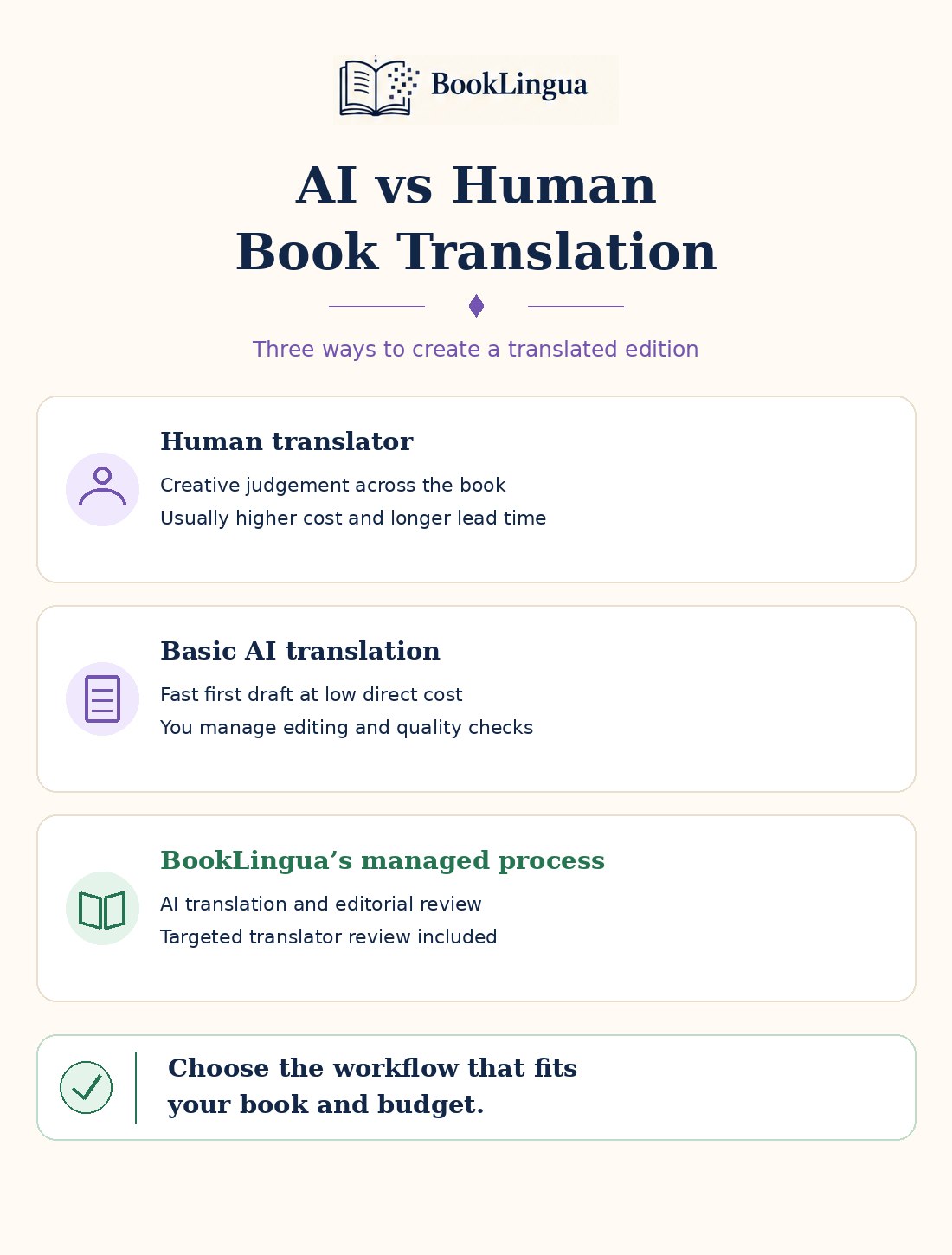
AI has changed all that. Authors can now hire a professional literary translator, use an AI translation tool or choose a managed process that combines AI translation with structured editing and input from a professional translator.
Each option has its advantages, and the right one depends on your budget, timescale, book and publishing goals.
In this guide, I’ll compare AI book translation with traditional human translation, including where each works well, where it can struggle and what I think authors should look for before choosing.
AI book translation vs human translation at a glance
| AI book translation | Human book translation | Managed AI and human review | |
|---|---|---|---|
| Cost | Usually the lowest-cost option | Usually the most expensive | More affordable than full human translation |
| Speed | Fast | Often takes several months | Faster than traditional translation, with time allowed for editing and review |
| Literary judgement | Limited without strong instructions and editing | Strong when working with the right literary translator | AI creates the draft; editing and professional feedback improve it |
| Consistency | Can be strong with a clear brief and terminology controls | Depends on the translator and editorial process | Structured checks can improve consistency across the full manuscript |
| Author involvement | Varies greatly by tool | Usually collaborative | Author brief guides the translation and review process |
| Publishing support | Often translation only | Usually translation only unless agreed separately | Can include files and launch materials for publishing in the new market |
| Best suited to | Testing a market or producing a draft | Prestige projects and books needing extensive creative adaptation | Independent authors seeking a practical balance of cost, quality and speed |
What is human book translation?
Human book translation is the traditional approach. A professional translator reads the manuscript and rewrites it in the target language, making thousands of decisions about meaning, tone, rhythm and cultural context.
This is much more than replacing one word with another. A good literary translator considers questions such as:
- Would this joke make sense to a reader in the new language?
- Does the dialogue sound natural for the character?
- Should an idiom be translated directly or replaced with a local equivalent?
- How should invented terms, nicknames and repeated phrases be handled?
- Does the emotional tone of the scene still work?
For books with highly stylised prose, experimental language, dense humour or a great deal of wordplay, an experienced literary translator can provide a level of creative judgement that AI alone cannot reliably match.
The main obstacle is cost. A novel contains tens of thousands of words, and translating it properly requires a substantial amount of skilled work. I know many indie authors through my work in publishing, and for most of them the question is not whether they value a professional translator. It is whether they can risk spending thousands on a new market before they know if readers are there.
It also takes time. The translator needs to read, translate, research, revise and often discuss decisions with the author. That process may take months rather than days or weeks.
What is AI book translation?
AI book translation uses a language model or machine-translation system to create a translated version of a manuscript.
This makes the initial translation dramatically faster and cheaper than commissioning a person to translate every sentence manually. For me, that is the genuinely exciting part of AI translation: it can give authors access to markets that would otherwise be financially out of reach.
But there is an important distinction between translating a book with AI and simply uploading a manuscript to a general-purpose chatbot. I would not upload a novel, ask for German and assume the job was done. A fluent-looking file can still contain mistakes that are surprisingly difficult to spot if you do not speak the language.
A book is a long, connected work. Character voices, place names, invented vocabulary, levels of formality and important plot details must remain consistent across many chapters. A sentence can be grammatically correct while still feeling wrong for the scene or character.
The quality therefore depends on the wider process around the AI. A translation brief, terminology controls, multiple editing passes, validation checks and targeted human review can make a significant difference.
Is human translation better than AI translation?
In my view, if quality is the only consideration and you can afford an excellent literary translator with relevant genre experience, then a full human translation remains the strongest option for many books.
But for most indie authors it usually boils down to:
Is a full human translation likely to earn back its cost, or is there a more affordable way to enter the market with a credible, readable book?
For an established bestseller with a publisher funding the translation, a traditional literary translator may be the obvious choice. But that is not the position most independent authors I speak to are in. If you are testing German, French or another market for the first time, the financial calculation is different.
AI translation can lower the cost of that experiment. That was one of my reasons for publishing a German edition of Bride of the Hollow King: I wanted to experience the process as an author, not just as the person behind a translation service.
The trade-off is that the output needs careful management and realistic expectations. Even after editing, a translated book may still feel translated in places. The goal should be a clear, consistent and enjoyable reading experience, not a promise that every reader will believe the book was originally written in their language.
Where AI book translation performs well
AI can be particularly useful when:
- the source manuscript is clear, polished and consistently formatted;
- the author provides a detailed translation brief;
- character names, invented terms and recurring phrases are documented;
- the prose is relatively direct;
- the translation goes through structured editing and quality checks;
- the author wants to test demand in a new language without committing to the cost of full human translation.
AI can translate a large manuscript remarkably quickly. It can also keep names, places and important terms consistent, but only if the right checks and instructions are built into the process. A powerful AI tool on its own does not automatically produce a book that is ready to publish.
I see the first translation as a draft, not the finished book. It still needs to be checked for missing or added text, formatting mistakes, inconsistent terms and places where the tone or meaning may have changed.
Where AI translation can struggle
AI does not understand or experience a story in the same way as a human reader or translator. It can produce sentences that sound completely natural but contain small changes in meaning. These mistakes are easy to miss because, at first glance, the translation appears to read well.
Character voice
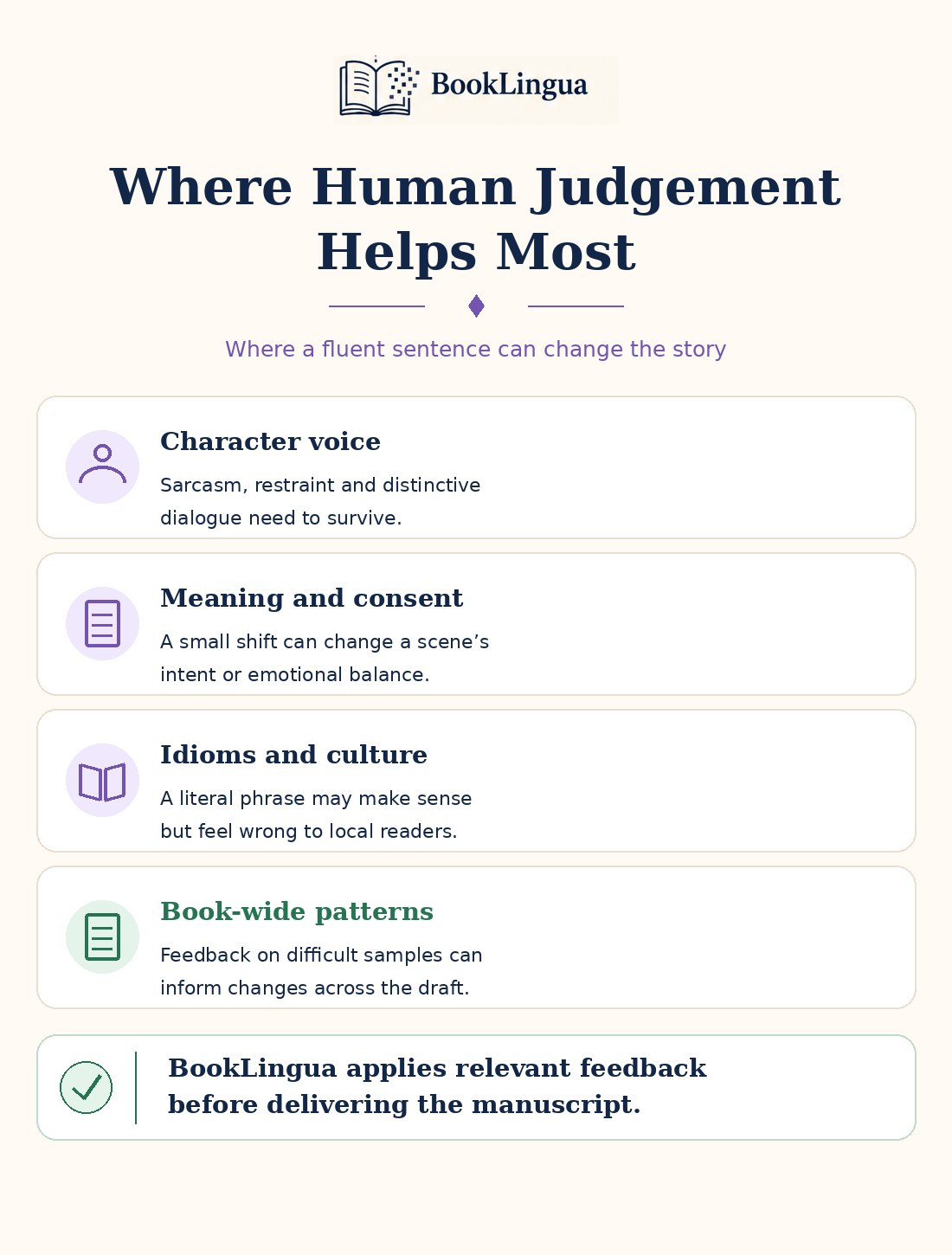
AI can sometimes make very different characters sound strangely similar. Your sarcastic heroine, immortal fae warrior and small-town baker can all end up sounding like the same overly polite customer-service representative. Humour, awkwardness, regional speech and a character’s rougher edges can easily get smoothed away unless the AI is given clear instructions and the translation is properly edited afterwards.
Idioms and humour
A literal translation may preserve the words while losing the joke. Alternatively, the AI may invent a local equivalent that changes the meaning or does not fit the character.
Romance, intimacy and consent
Small changes in a verb, hesitation or refusal can alter the balance of a scene. This is especially important in romance, where tone, agency and emotional subtext matter as much as the literal dialogue.
Long-range consistency
A term translated one way in chapter two may appear differently in chapter twenty. Titles, magical systems, nicknames and formal forms of address all need consistent treatment.
Cultural context
A reference that is obvious to readers in the original market may be confusing elsewhere. AI can identify some of these issues, but it cannot reliably decide how much cultural adaptation is appropriate for every book.
Why professional translators still matter in an AI-led process
This is why I do not think the choice has to be AI or human.
A professional translator can add particular value by reviewing carefully selected samples from the manuscript, especially passages that are linguistically difficult, culturally sensitive or central to the book’s voice. When we select samples at BookLingua, we deliberately look for the difficult material rather than choosing a few easy paragraphs that are unlikely to tell us much.
That feedback can reveal patterns that affect the wider translation. For example, the reviewer may identify that a character sounds too formal, an important term has been interpreted incorrectly or the tone of intimate scenes needs adjusting.
For me, the key is what happens next. We assess the translator’s feedback and apply relevant improvements to the translated manuscript before delivery. This does not turn a targeted review into a line-by-line human translation. It provides expert input where it is most useful while keeping the overall project affordable.
Read more about BookLingua’s editorial review process.
A better comparison: process, not just technology
When I compare translation services, I don’t just ask whether they use AI or humans. I ask what happens from upload to delivery—and I’d encourage all authors to do the same.
Useful questions include:
- Can I provide instructions about characters, tone and terminology?
- Does the manuscript receive more than one editing pass?
- How does the service check for missing, duplicated or untranslated text?
- Is professional translator review included, and what exactly is reviewed?
- Is the translator’s feedback applied to the book?
- Will I receive a usable DOCX or EPUB file?
- Does the service help me prepare the translated edition for sale?
Two services may both describe themselves as AI book translation platforms while providing very different levels of editorial work.
Which option is right for your book?
Choose full human translation if:
- you have the budget for a skilled literary translator;
- the book relies heavily on wordplay, dialect or experimental prose;
- you already have proven demand in the target market;
- a publisher or rights partner is funding the project;
- you want a highly collaborative, sentence-by-sentence creative process.
Choose a basic AI translation tool if:
- you mainly need a rough translation for internal use;
- you can review the target language yourself;
- you have your own editor or proofreader;
- you are comfortable managing formatting, consistency and publishing preparation.
Choose a managed AI translation service like BookLingua if:
- a full human translation is outside your budget;
- you want more support than a one-click translation tool provides;
- you need the manuscript edited and checked before delivery;
- you want professional feedback on challenging sections;
- you want a practical route to publishing the book in a new market.
How BookLingua combines AI translation with professional review
I built BookLingua for authors who want to reach international readers without taking on the cost and complexity of a traditional full-book translation.
The process we use includes:
- an author translation brief covering voice, tone, characters and terminology;
- AI translation designed for full-length books;
- two editing passes to improve accuracy, readability and consistency;
- checks for structural and formatting problems;
- targeted review of particularly challenging samples by a professional translator;
- assessment and application of relevant translator feedback to the full draft;
- a report explaining the professional review;
- translated files prepared for the author’s next publishing steps;
- launch materials to help with positioning, keywords and marketing in the target language.
To be clear, a targeted professional review is not the same as having a translator rewrite and proofread every word. Instead, BookLingua combines the speed and affordability of AI with editorial controls and expert input at the points where they can have the greatest impact.
When I published the German edition of Bride of the Hollow King, the experience also reinforced that translation is only part of the job. You still need to think about the book description, categories, keywords, pricing, cover and the practical business of getting the edition onto Amazon. That is why our delivery includes launch materials rather than stopping at the translated manuscript.
Our step-by-step AI translation guide explains the wider process. When the translation is ready, use our guide to publishing a translated book on Amazon KDP.
The bottom line
Human translation offers the highest level of creative involvement, but its price can make it inaccessible to independent authors, particularly when they are entering an untested market.
Basic AI translation is fast and inexpensive, but the raw output is rarely the whole job.
For many of the authors I know, the most practical option sits between the two: use AI to make book translation financially possible, then strengthen the result through a clear brief, structured editing, quality checks and targeted professional review.
I don’t see that as a shortcut around quality. It is a different publishing model which gives more authors a realistic opportunity to reach readers in other languages.
See what your translation could cost
Enter your manuscript’s word count and choose your target languages in the BookLingua pricing calculator.